

 English - EN
  繁體 - ZH-TW
  简体 - ZH-CN
  Español - ES
  日本語 - JA
  العربية - AR
  Русский - RU
  Français - FR
From Middle East Oil to Formosan Forests: The Surprising Origins of Taiwan’s Plastic Kingdom
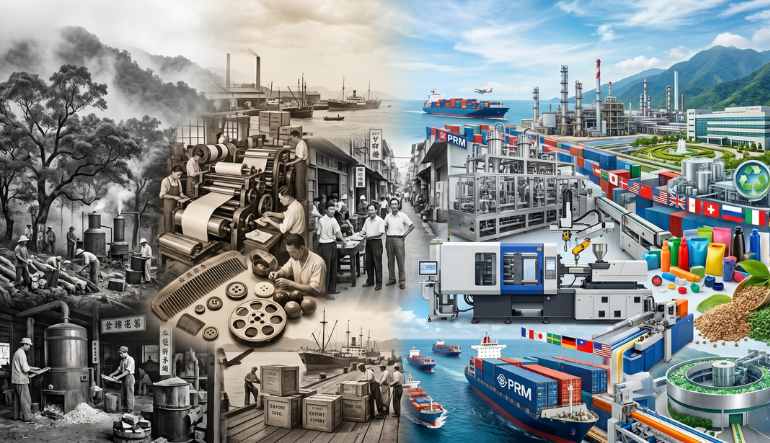
The global plastics market is currently navigating a period of profound uncertainty. With geopolitical instability in the Middle East—the world’s primary artery for petroleum and plastic resins—supply chains are feeling the squeeze, and prices are fluctuating wildly. This modern crisis serves as a stark reminder of how deeply the industry is tethered to oil.
But what if I told you that Taiwan’s journey to becoming a global "Plastic Kingdom" didn't start with petroleum? In fact, long before the first oil refinery was built on the island, Taiwan held a dominant 70% to 80% share of the world’s supply of the earliest mass-produced plastic material.
Considering Taiwan does not produce a single drop of crude oil, how did it conquer the world stage? The answer lies in a mysterious, organic raw material that predates modern synthetics: Celluloid.
The Camphor Connection: Taiwan’s "White Gold"
To understand Taiwan’s plastic history, we must look at the mountains, not the sea. In the late 19th and early 20th centuries, Taiwan was the world's leading producer of camphor. Extracted from the ancient camphor trees blanketing the island’s central mountain ranges, this aromatic crystalline substance was known as "White Gold."
While camphor had medicinal uses, its most revolutionary application was as a plasticizer. When combined with nitrocellulose, it created Celluloid—the world’s first semi-synthetic plastic.

During this era, celluloid was the "high-tech" material of its day. It was used to manufacture everything from film stock for the burgeoning movie industry to billiard balls, tortoiseshell-imitation combs, and waterproof shirt collars. Because Taiwan controlled the camphor, it essentially controlled the global celluloid market. This established the foundational "DNA" of Taiwan’s manufacturing sector: the ability to process raw materials into high-demand global commodities.
The Pivot to Petrochemicals: Post-War Transformation
As the mid-20th century approached, the limitations of celluloid (notably its extreme flammability) led to the rise of petroleum-based polymers. Taiwan, having already built a robust logistics and trade infrastructure through the camphor trade, was uniquely positioned to pivot.
In the 1950s and 60s, the Taiwanese government and visionary entrepreneurs recognized that the future lay in PVC (Polyvinyl Chloride). Despite the lack of domestic oil, Taiwan imported crude and invested heavily in upstream cracking facilities. This was the birth of the "Taiwan Miracle." Small family-run workshops began popping up across the island, turning plastic pellets into toys, shoes, and household goods that would eventually be exported to every corner of the globe. The "Made in Taiwan" label became synonymous with the versatility of plastic.

From Material to Machinery: The Modern Era
Today, Taiwan has evolved far beyond just supplying raw materials or cheap finished goods. The industry has shifted toward high-end Plastic & Rubber Machinery. Leveraging decades of processing knowledge, Taiwanese manufacturers now lead the world in producing energy-efficient injection molding machines, sophisticated extrusion lines, and cutting-edge recycling systems.
In an era where "Sustainability" and "Smart Manufacturing" are the new industry standards, Taiwan is once again leading. From developing biodegradable bioplastics to implementing AI-driven Industry 4.0 solutions that optimize OEE (Overall Equipment Effectiveness), the spirit of innovation that began with camphor trees continues to thrive.
Conclusion: A Legacy of Resilience
The current volatility in the Middle East highlights the vulnerability of the petroleum-dependent model. However, Taiwan’s history proves that the strength of a "Plastic Kingdom" isn't found in the oil under the ground, but in the ingenuity of its people and the adaptability of its supply chains.
From the celluloid films of the 1900s to the circular economy solutions of 2026, Taiwan remains the high-value bridge for global buyers seeking reliability in a changing world.




COOPERATIVE PARTNER