

 English - EN
  繁體 - ZH-TW
  简体 - ZH-CN
  Español - ES
  日本語 - JA
  العربية - AR
  Русский - RU
  Français - FR
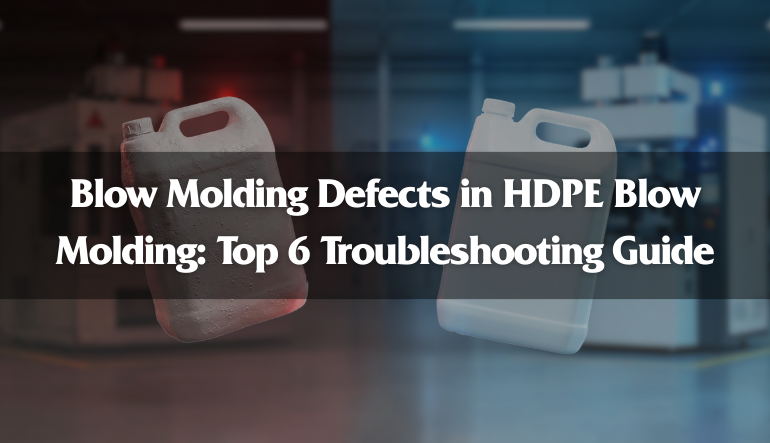
Blow Molding Defects in HDPE Blow Molding: Top 6 Troubleshooting Guide
HDPE blow molding is a manufacturing process used to create hollow plastic parts by inflating a heated plastic tube (parison) until it fills a mold cavity. While efficient for mass production, manufacturers frequently encounter specific defects in blow molding products.
This guide provides a structured analysis of the top 6 blow molding defects, identifying their root causes and actionable technical solutions to optimize production OEE.
Quick Reference: Blow Molding Defects & Solutions Table
| Defect Type | Primary Symptom | Root Cause | Recommended Solution |
| 1. Leakage | Fluid escaping from sealed areas | Poor welding or contaminated resin | Clean die head; Align blow pin & mold; Check resin purity |
| 2. Rocker Bottoms | Unstable, wobbling base | Insufficient cooling or trapped air | Increase cooling water flow; Ensure air exhaust in blow pin |
| 3. Weld Line Tearing | Cracks at pinch-off points | Mold closing too fast/slow | Adjust "Slow Mold Close" speed; Thicken parison at pinch-off |
| 4. Surface Defects | Black spots, bubbles, or ripples | Moisture, degradation, or cold mold | Use hopper dryers; Clean extruder; Optimize die mouth size |
| 5. Uneven Thickness | Warping or thin spots | Misaligned die mandrel | Re-align die mandrel; Adjust parison profile control |
| 6. Trim Defects | Flash not removing cleanly | Low clamping force or hot flash | Match mold size to machine tonnage; Enhance flash cooling |
Detailed Analysis: Causes and Fixes
1. Leakage
Definition: Failure of the container to hold liquid due to compromised structural integrity.
-
Cause 1 (Material): Impurities in recycled HDPE prevent proper fusing of the plastic walls.
-
Fix: Inspect resin quality and filter mesh.
-
-
Cause 2 (Tooling): Misalignment between the blow pin nozzle and the mold. If the gap is too wide, the neck finish will be uneven.
-
Fix: Adjust tooling to ensure the blow pin forces material into the void, creating a flat, sealable top surface.
-
2. Rocker Bottoms (Unstable Base)
Definition: A deformation at the base of the bottle causing it to wobble.
-
Cause 1 (Thermal): Insufficient cooling time allows the plastic to deform after ejection.
-
Fix: Increase water flow in the mold’s bottom cooling channels.
-
-
Cause 2 (Pneumatic): Trapped air pressure inside the bottle expands the bottom outward after the mold opens.
-
Fix: Configure the blow pin to slightly retract/exhaust air before the mold opens.
-
3. Tearing at Welding Lines
Definition: Material failure at the pinch-off areas (bottom or handle) during flash removal.
-
Cause: Improper mold closing speed profile.
-
Fix: Implement a two-step mold closing process. Reduce the speed of the final "slow close" phase to push material inward, reinforcing the weld line.
-
-
Cause: Thin parison profile.
-
Fix: Increase parison thickness specifically at the handle and bottom pinch-off points.
-
4. Surface Wall Defects
Definition: Aesthetic or structural imperfections on the exterior wall.
-
Black Spots: Caused by degraded resin (carbon buildup) in the extruder die head. Fix: Perform a thorough die head cleaning.
-
Wall Bubbles: Caused by moisture turned into steam. Fix: Install a hopper dryer to remove humidity from the resin.
-
Orange Peel: Caused by the parison contacting a cold mold, solidifying, and stretching again. Fix: Use a larger die mouth to reduce the pre-blow ratio.
5. Uneven Radial Wall Thickness
Definition: Inconsistent wall thickness leading to uneven cooling rates and shrinkage.
-
Cause: The extruded parison is not hanging straight or the die mandrel is off-center.
-
Fix: Calibrate the die mandrel alignment until the parison flows vertically straight.
-
6. Finish Trim Defects
Definition: Difficulty in separating the excess material (flash) from the finished product.
-
Cause (Machine Selection): Using a small mold on a machine designed for large volumes leads to off-center clamping force.
-
Fix: Always run molds on machines with appropriate tonnage and platen dimensions.
-
-
Cause (Cooling): Flash is too hot to snap off brittly.
-
Fix: Reduce parison thickness in the flash area to accelerate cooling.
-
Frequently Asked Questions (FAQ) about HDPE Blow Molding
Q: What causes black spots in HDPE blow molding? A: Black spots are typically caused by carbonized (degraded) resin or foreign contamination stuck inside the extruder die head. Regular purging and cleaning of the die head solves this issue.
Q: How do you fix a rocker bottom on a plastic bottle? A: To fix a rocker bottom, ensure the mold cooling system is functioning correctly (increase water flow) and verify that internal air pressure is exhausted through the blow pin before the mold opens.
Q: Why is the pinch-off tearing on my blow molded part? A: Tearing at the pinch-off usually indicates that the mold closing speed is too fast at the final stage, or the parison is too thin at the weld point. Slowing down the final mold clamp and thickening the parison profile usually resolves this.
Conclusion: Machine Precision Matters
Minimizing defects in blow molding products requires a combination of skilled troubleshooting and high-precision equipment. Machines with advanced parison control and stable clamping systems significantly reduce rejection rates.
Looking for high-efficiency solutions? Taiwan’s manufacturers offer world-class technology for HDPE blow molding.
Explore Top Blow Molding Machine Suppliers: Browse Blow Molding Machines on PRM-Taiwan

We have over 200 of the biggest and many of the smallest Taiwanese machinery manufacturers on our site and contacts with many more. Whether you are looking for full lines such as, recycling machines extruders, blow molding machines, injection molding machines and printing machines, or auxiliary equipment and parts such as gearboxes, barrels, screws, molds, dies, control systems and virtually anything related to the plastic and rubber industries including packaging. If it’s made in Taiwan, we will find it for you!