

 English - EN
  繁體 - ZH-TW
  简体 - ZH-CN
  Español - ES
  日本語 - JA
  العربية - AR
  Русский - RU
  Français - FR
The Science of "Self-Destruction": Rutgers' New Plastic May Be The Game Changer
In the plastics industry, we have grown accustomed to a cycle of hype and disappointment. We hear about "green solutions" constantly, yet the global plastic pollution curve rarely bends.
Most "biodegradable" options on the market, such as Polylactic Acid (PLA), are better than traditional petroleum plastics, but they come with significant caveats. First, they are passive; they rely on specific environmental conditions—high heat, humidity, and microbes—to degrade.
Moreover, many biodegradable plastics currently on the market have compromised on performance. They are often brittle, weak, or prone to breaking too easily, contradicting the very purpose of using plastic in the first place: durability.
The latest breakthrough from Rutgers University changes this narrative completely. It introduces a material that is active, programmable, and capable of breaking down thousands of times faster.
Here is the scientific breakdown of why this technology is structurally superior and what it could mean for the future of the supply chain.
How the "Self-Destruct" Works: Programmable Depolymerization
The core difference lies in how the material falls apart. Traditional degradation is often a process of fragmentation—breaking big pieces into smaller microplastics. The Rutgers innovation is designed for depolymerization—unzipping the chain back to its original building blocks.
- The "Backbone" Structure: The scientists synthesized a thermoplastic polymer incorporating a specific chemical bond that acts as a "photoswitch." In standard ambient light or darkness, these bonds are incredibly stable, providing the durability needed for packaging or appliance casings.
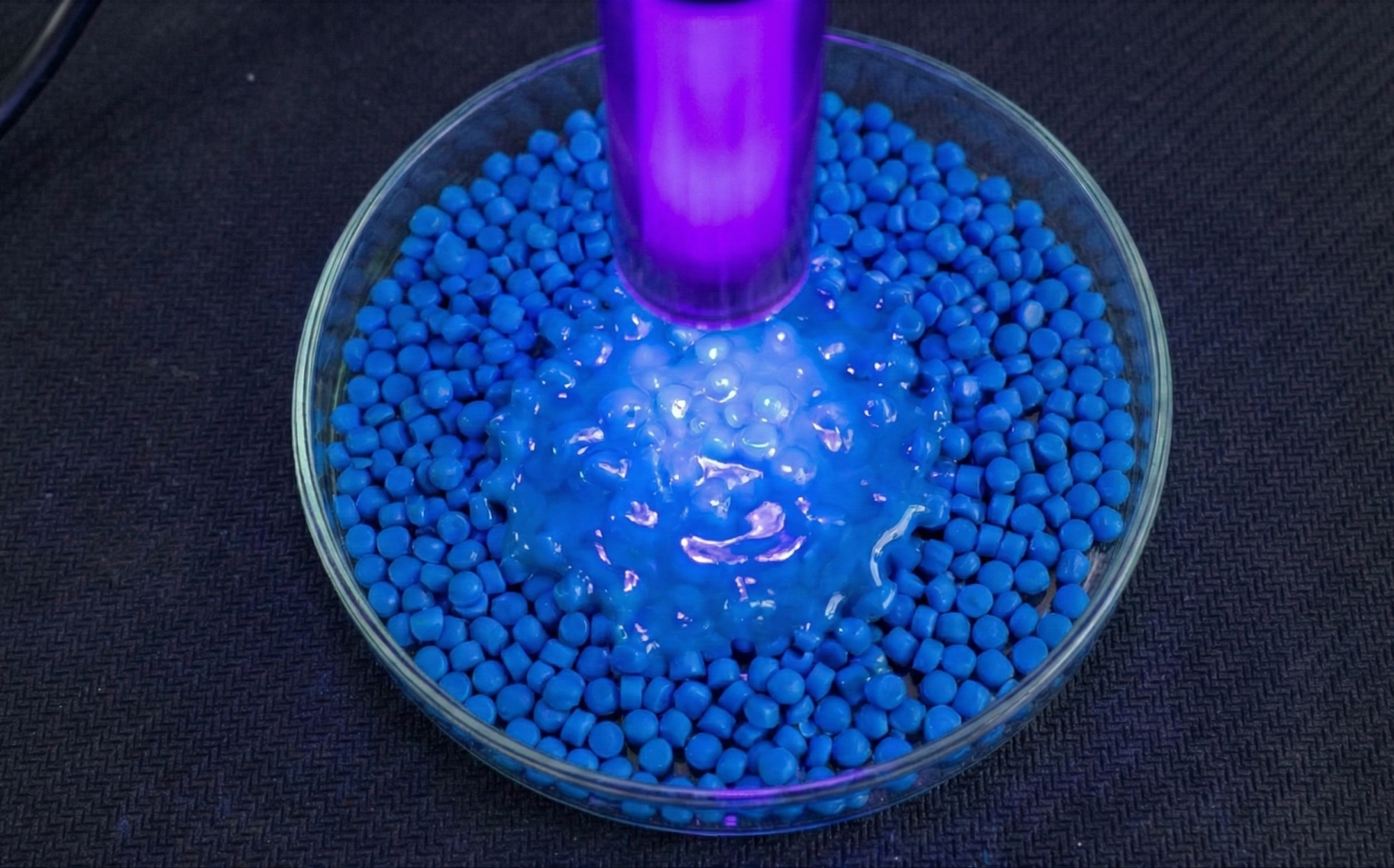
- Photocatalytic Trigger: When exposed to a specific spectrum of UV light, the polymer undergoes rapid chain scission. This isn't a slow erosion; it is an instant chemical reaction that severs the bonds holding the material together.
- Solid to Liquid: The result is visually striking. The solid plastic does not crumble; it dissolves into liquid monomers.
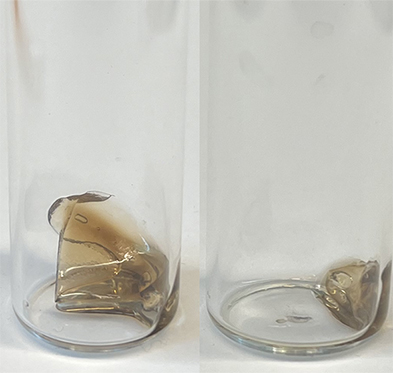
A poly(dicyclopentadiene) plastic, with chemical structure designed to break down on its own at normal room conditions. On the left is the original sample; on the right is the same sample after 18 hours in the open air. Photo: Gu Lab, Rutgers University.
The Power of Programmability This technology allows manufacturers to engineer the same plastic to break down over days, months, or even years, depending on the specific application.
This fine-tuning capability means product lifespans can be matched to their purpose. One-time use packaging might only need to last a day before it disintegrates, while car parts must endure for years. The research team demonstrated that this breakdown mechanism can be built-in or triggered externally using ultraviolet light or metal ions, adding a crucial layer of control.
Scientific Comparison: Biology vs. Physics
Why is this "thousands of times faster" figure significant? It highlights the difference between relying on biology versus relying on physics and chemistry.
Traditional PLA (Hydrolysis):
- Mechanism: Water molecules and enzymes from microbes slowly "eat" the ester bonds.
- Limitation: It is highly environment-dependent. In a cold ocean or a dry landfill, PLA can last for years, behaving much like PET.
- End Product: Biomass, CO2, and water. While it disappears, the material value is lost.
Rutgers Photopolymer (Photolysis):
- Mechanism: High-energy photons directly cleave the polymer chain.
- Advantage: It is controllable. The degradation happens on demand, regardless of bacterial presence.
- End Product: Monomers. This is the game-changer. The resulting liquid can be collected, purified, and re-polymerized into new plastic with significantly higher efficiency.
The Industry Shift: From Waste to Resource
For global buyers and machinery manufacturers, this technology signals a shift toward Chemical Recycling.
If this material reaches mass production, we will see a demand for a new class of recycling infrastructure. Instead of mechanical shredders and washers, the "recycling plants of the future" might look more like chemical labs, equipped with UV reactor tanks designed to recover monomers.
This isn't just about reducing pollution; it's about closing the loop efficiently. For the first time, we are looking at a plastic that is designed to die—so it can be born again.
Editor's Take: The "Mosaic" Strategy – Diversification, Not Replacement
While the headline-grabbing speed of this new material is captivating, we must temper excitement with realism. The breakthrough from Rutgers University should not be viewed as a "silver bullet" intended to replace all existing plastic solutions. Instead, it serves to diversify our arsenal in the global war against plastic pollution.
In material science, there is no single solution that fits every scenario. The future of the plastics economy relies on a "Mosaic Strategy"—using the right material for the right application to maximize efficiency and minimize waste.
1. The Unshakable Role of Mechanical Recycling For clean, standardized waste streams like PET bottles or HDPE jugs, traditional mechanical recycling (washing, shredding, and re-extruding) remains the king of efficiency. It is energy-efficient and the infrastructure is already mature. It would be counterproductive to replace these recyclable materials with degradable ones.
2. The Necessity of Compostables (PLA/PBAT) Biodegradable plastics hold a specific and vital crown: food-contaminated applications. In industrial composting facilities, materials like PLA can be processed alongside organic food waste to create soil—a function that neither mechanical recycling nor the new photodegradable plastics can perform.
3. The Strategic Niche for Rutgers’ Innovation So, where does the new "self-destructing" plastic fit? It is the perfect solution for high-leakage risk items. These are products that often escape waste management systems and end up in the ocean. This technology acts as a safety net, ensuring that if plastic does leak into the environment, it won't persist for centuries.
Conclusion The goal isn't to find one material to save the planet. The goal is to build a diverse ecosystem where mechanical recycling, composting, and this new "programmable degradation" work in parallel. Rutgers has provided a powerful new tool to fill a critical gap that our current technologies could not cover.
Stay tuned to PRM-Taiwan for the latest updates on sustainable machinery and material solutions.
Source:
We have over 200 of the biggest and many of the smallest Taiwanese machinery manufacturers on our site and contacts with many more. Whether you are looking for full lines such as, recycling machines extruders, blow molding machines, injection molding machines and printing machines, or auxiliary equipment and parts such as gearboxes, barrels, screws, molds, dies, control systems and virtually anything related to the plastic and rubber industries including packaging. If it’s made in Taiwan, we will find it for you!