

 English - EN
  繁體 - ZH-TW
  简体 - ZH-CN
  Español - ES
  日本語 - JA
  العربية - AR
  Русский - RU
  Français - FR
Horizontal vs. Vertical Injection Molding Machines: Which Clamp Orientation Wins Your Production Line?
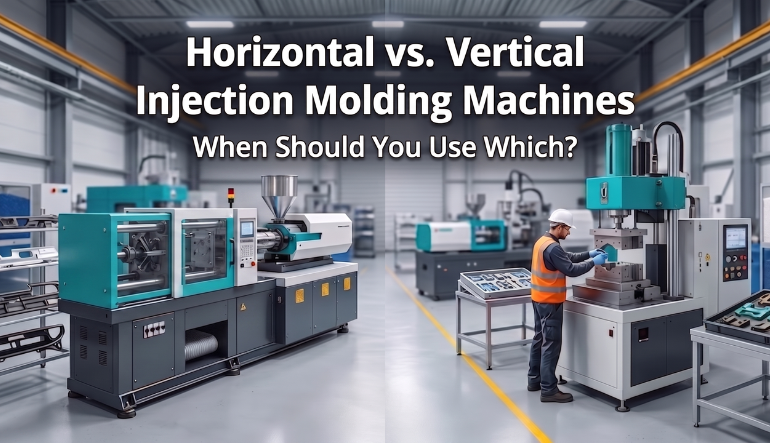
The injection molding machine is one of the most versatile pieces of equipment in plastics manufacturing, but not all injection molding machines are built the same way. Walk onto two different factory floors and you might see a press the length of a bus running automotive bumpers, and right next to it, a compact machine barely bigger than a filing cabinet turning out connectors with metal pins already molded inside. Both are injection molding machines. The difference between them comes down to one design decision: which way the clamp and injection unit are oriented.
That single choice — horizontal or vertical — determines what a machine can produce, how it handles automation, and how much floor space it eats up. Get it wrong and a manufacturer ends up fighting gravity, cycle time, or both. This guide breaks down what actually separates horizontal from vertical injection molding, where each one wins, and which Taiwanese manufacturers lead each category.
The Core Difference: Clamp Orientation and Gravity
A horizontal injection molding machine opens and closes its mold sideways, parallel to the floor, with the injection unit feeding material along that same horizontal axis. This is the machine most people picture when they hear "injection molding" — it's the industry's general-purpose workhorse.
A vertical injection molding machine flips that orientation. The clamp opens and closes up and down, and the injection unit typically sits on top, injecting downward into a mold where the parting line runs horizontally.
That difference sounds cosmetic. It isn't. In a horizontal machine, gravity works against the moving mold half, which is fine for high-tonnage, high-volume production but makes it awkward to hold anything else — like a metal insert — in place during the shot. In a vertical machine, the lower mold half faces straight up. A metal terminal, an electrical connector, or a pre-placed component simply lies flat in the cavity while the top half closes down onto it. Gravity does the fixturing work for free.
That's the entire logic behind why vertical machines dominate insert molding and overmolding, and why horizontal machines dominate everything else. Once you understand the clamp orientation and what gravity does to the part inside it, every other difference on the spec sheet — tonnage range, footprint, automation style — falls out as a consequence.
| Horizontal | Vertical | |
| Clamp movement | Side to side, parting line vertical | Up and down, parting line horizontal |
| Typical tonnage | 50 to 4,000+ tons | 15 to 500 tons (specialized units run higher) |
| Footprint | Long, runs the length of the floor | Compact, stacks vertically |
| Part ejection | Gravity-assisted; parts drop free | Requires more deliberate handling |
| Best suited for | High-volume, large parts, PET preforms, automotive components | Insert molding, overmolding, LSR/silicone parts, small precision parts |
| Typical automation | Robot arms and conveyors for take-out | Rotary or shuttle tables for insert loading |
Where Horizontal Machines Win
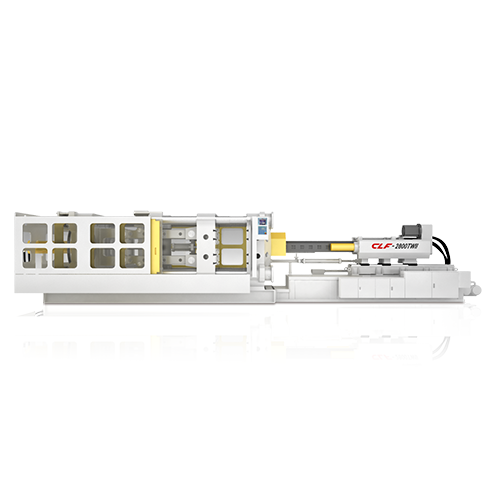
Sample photo of Horizontal Injection Molding Machine (Chuan Lih Fa - CLF)
Horizontal machines are the default for a reason: once a part drops out of the mold, gravity pulls it straight down and out, which makes full automation with take-out robots and conveyor lines simple. That's why horizontal presses dominate high-volume production — automotive bumpers and dashboards, appliance housings, packaging, caps and closures, PET preforms, and anything else where the priority is cranking out large volumes of parts as efficiently as possible.
Horizontal machines also carry the widest tonnage range in the industry, from compact 50-ton presses up to two-platen giants clearing 4,000 tons and beyond, which is why they handle everything from small precision components to car bumpers and industrial pallets on the same basic architecture.
Where Vertical Machines Win
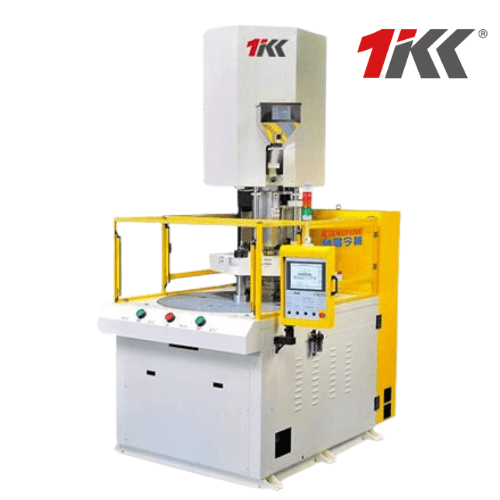
Sample photo of Vertical Injection Molding Machine (Taiwan Kinki - TKC)
Vertical machines are the specialist's tool, and their specialty is insert molding and overmolding. Because the lower mold half faces up, an operator or robot can lay a metal terminal, a wire, or a pre-molded component flat in the cavity and let gravity hold it in place while the machine closes. Try that on a horizontal machine and the insert has to be held vertically against gravity — doable, but nowhere near as clean.
That's why vertical presses show up everywhere insert molding matters: electrical connectors and cable overmolding, automotive sensors, medical device components, and multi-material or multi-color parts built on rotary or shuttle tables that let an operator load inserts at one station while molding happens at another. Vertical machines are also the standard choice for liquid silicone rubber (LSR) and solid silicone parts, low-pressure encapsulation for electronics, and compact production lines where floor space is at a premium — a small vertical press can cost a fraction of an equivalent horizontal machine, which is part of why they're so common for lower-tonnage specialty work.
Tonnage on vertical machines typically tops out lower than horizontal — most standard models run 15 to 500 tons — though specialized vertical-clamp, horizontal-injection hybrids can push well past that for larger insert-molded parts.
How to Choose the Right Machine for Your Production Line
The decision usually comes down to three questions:
- Does the part need an insert, overmold, or multi-material shot? If yes, start with vertical.
- Is this high-volume production of a large, single-material part? Horizontal is almost always the better fit.
- How much floor space do you actually have? Vertical machines pack a smaller footprint per ton of clamping force, which matters in space-constrained facilities or cleanroom environments.
Many manufacturers run both. A production floor building automotive components, for instance, might use horizontal presses for large single-shot housings and vertical presses down the line for the connectors and sensors that go inside them.
Top 5 Horizontal Injection Molding Machine Manufacturers
1. ARBURG — Germany
Founded in 1923 near Stuttgart and still fully family-owned by the Hehl and Keinath families, Arburg built its reputation on the ALLROUNDER platform — a modular hydraulic, hybrid, and electric line running roughly 14 to 730 US tons that's designed to be reconfigured across a huge range of parts on the same base machine. Production stays concentrated at a single plant in Lossburg, Germany, which the company treats as central to its quality control, and its customer base skews heavily toward medical and precision packaging molding.
2. Fu Chun Shin (FCS) — Taiwan

Established in 1974, FCS is Taiwan's largest injection molding machine manufacturer and the first — and so far only — publicly listed company in the country's injection molding industry. Its horizontal line spans roughly 30 to 4,000 tons, covering everything from small precision components to large two-platen and multi-component systems, with energy-saving hydraulic and all-electric options across the range.
3. Husky — Canada

Founded in 1953 in Bolton, Ontario, Husky is the horizontal machine most of the global beverage industry runs on: it's the world's largest maker of PET preform molds and machines, with its HyPET platform running high-cavitation tooling up to 200 cavities for bottle preform production. Beyond PET, its Hylectric and HyCAP platforms extend into thinwall food containers, closures, and medical or pharmaceutical molding, all built on the same high-speed horizontal architecture that made its name in packaging.
4. Chuan Lih Fa (CLF) — Taiwan
Founded in 1966, CLF has built a nearly 60-year reputation on large and very-large tonnage horizontal machines, running from 60 tons up to 5,000-ton two-platen systems for automotive bumpers, dashboards, pallets, and large containers. Its toggle and two-platen platforms are engineered specifically for the largest single-shot parts on the market.
5. Haitian International — China

Founded in 1966 in Ningbo, Haitian International is the world's largest producer of injection molding machines by volume, turning out an estimated 40,000 to 50,000 machines a year for customers in more than 160 countries. Its horizontal range runs from 44 tons up to record-setting territory — the company built and delivered an 8,800-ton two-platen machine to a French manufacturer in 2023, believed to be the largest injection molding machine ever produced — with servo-hydraulic, hybrid, and all-electric platforms covering everything in between.
Top 5 Vertical Injection Molding Machine Manufacturers
1. Taiwan Kinki (TKC) — Taiwan
With roughly 40 years of experience, Taiwan Kinki builds almost exclusively vertical injection molding machines, and was the first Taiwanese vertical-machine maker to pursue UN ESG standards. Its KET all-electric series, tie-barless KC series, and high-capacity KR series run from 15 tons up to custom units at 800 tons, with insert molding, rotary and slide tables, and rubber/silicone presses across the lineup.
2. NISSEI — Japan
Founded in 1947 by Katashi Aoki in Sakaki, Japan, NISSEI has shipped more than 125,000 machines to over 80 countries and holds a foundational patent on the rotary-ram in-line screw injection mechanism still used industry-wide today. Its TNX and hybrid TWX-RIII vertical series were purpose-built for insert molding automation, using a low-profile clamping design that keeps mold height down and makes it easier to integrate takeout and articulated robots into high-volume insert work.
3. ENGEL — Austria
Founded in 1945 in Schwertberg and still 100 percent family-owned, ENGEL is one of the largest full-line injection molding machine builders in the world, with a horizontal range running up to 5,500 tons and deep roots in automotive, medical, and packaging molding. Its vertical machines follow the same automation-first approach — ENGEL has supplied university research labs with vertical presses specifically for insert-molding and composite R&D — making it a common single-source pick for manufacturers who want both machine types from one supplier.
4. Yuh Dak Machinery — Taiwan

Established in 1986 and part of the Huarong Group, Yuh Dak specializes in vertical machines from roughly 15 to 300 tons, with four-column vertical clamping for insert molding and two-color rotary tables built around 180-degree oscillation for multi-material parts — a common configuration for automotive weatherstrips and wire-plug components.
5. King's Solution — Taiwan
Operating since 1983, King's Solution builds vertical 4-tie-bar and 2-tie-bar machines alongside dedicated low-pressure molding (LPM) systems for electronics encapsulation, with energy-saving variable-pump hydraulics that cut power draw by up to half. Its rotary and double-slide table configurations are built specifically around insert molding and LSR production.
Frequently Asked Questions
Is a horizontal or vertical injection molding machine better?
Neither is universally better — they solve different problems. Horizontal machines win on volume, tonnage range, and large single-material parts. Vertical machines win on insert molding, overmolding, and compact, floor-space-limited production.
What is vertical injection molding used for?
Primarily insert molding and overmolding, where a metal or pre-formed component needs to sit flat in the mold before the plastic shot. Common applications include electrical connectors, cable overmolding, medical device components, and liquid silicone rubber (LSR) parts.
What's the typical tonnage range for each type?
Horizontal machines typically run from 50 to 4,000-plus tons. Vertical machines typically run from 15 to 500 tons, though specialized vertical-clamp/horizontal-injection hybrids can scale considerably higher for larger insert-molded parts.
Whether your production line needs the volume of a horizontal press or the precision of a vertical insert-molding system, PRM-Taiwan connects buyers directly with the manufacturers behind both — browse our Horizontal Injection Molding Machines and Vertical Injection Molding Machines categories to compare suppliers directly.
We have over 200 of the biggest and many of the smallest Taiwanese machinery manufacturers on our site and contacts with many more. Whether you are looking for full lines such as, recycling machines extruders, blow molding machines, injection molding machines and printing machines, or auxiliary equipment and parts such as gearboxes, barrels, screws, molds, dies, control systems and virtually anything related to the plastic and rubber industries including packaging. If it’s made in Taiwan, we will find it for you!
![[Taiwan Quick Facts] After the Pandemic, Taiwan's Plastics and Rubber Manufacturers have Made Remarkable Progress](/UserFiles/company/295/blog_pic/blog_1663918011.png)