

 English - EN
  繁體 - ZH-TW
  简体 - ZH-CN
  Español - ES
  日本語 - JA
  العربية - AR
  Русский - RU
  Français - FR
Extrusion vs. Injection & Stretch Blow Molding: Which Machine Fits Your Bottle or Container?
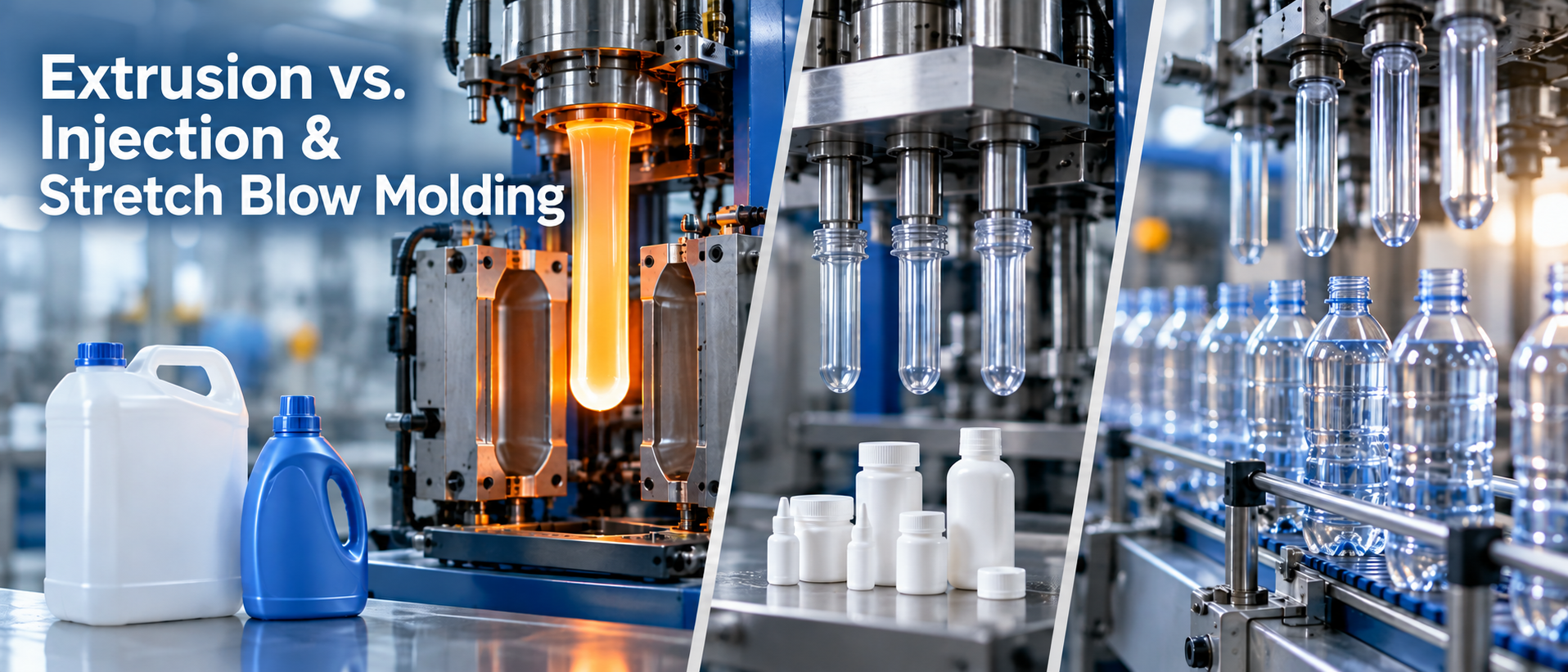
A shampoo bottle, a two-liter soda bottle, and a 20-liter jerry can are all made by "blow molding" but almost none of the machinery behind them is interchangeable. The soda bottle needs a process precise enough to survive carbonation pressure and stay crystal clear. The jerry can needs a process that can handle an oddly shaped, handle-equipped container nobody would ever try to injection mold. Same broad category of machine, three genuinely different ways of building it.
There are three main types of blow molding: extrusion blow molding (EBM), injection blow molding (IBM), and injection stretch blow molding (ISBM). Each starts from a different piece of pre-shaped plastic and ends up suited to a different shelf. This guide breaks down how each process actually works, where each one wins, and which manufacturers lead each category.
The Core Difference: Parison vs. Preform
Every blow molding process ends the same way: a piece of softened plastic is clamped inside a mold and inflated with compressed air until it takes the shape of the cavity, then cooled and ejected. Where the three processes split apart is what that piece of plastic is, and how it got there.
Extrusion blow molding
Starts with a parison, continuously extruded tube of molten plastic, open at both ends, that drops straight down from a die head. The mold closes around it, pinches the ends shut, and air is blown in through a blow pin. Because the parison is just an extruded tube, EBM can make almost any hollow shape, including containers with handles, offset necks, or irregular bends that no other process can touch.
Injection blow molding
Starts differently: the plastic is first injection molded into a "preform". A small, thick-walled tube with a fully finished neck and thread already formed around a core rod. That preform is then transferred (still on the core rod) to a blow station and inflated into the final container. Because the neck is injection molded to exact tolerance from the start, IBM produces very precise, blemish-free small containers, but it can't produce handled or oddly shaped parts the way EBM can.
Injection stretch blow molding
Adds one more step on top of IBM: before the preform is blown, a stretch rod pushes it out lengthwise first, orienting the plastic molecules along two axes instead of one. That biaxial orientation is what gives PET soda bottles the clarity, rigidity, and gas-barrier strength to hold carbonation, something a straight-blown bottle can't do. ISBM runs as either a single-stage process (injection, stretch, and blow all happen in one machine) or a two-stage process (preforms are injection molded separately, then reheated and blown on a dedicated stretch blow machine down the line).
| Extrusion (EBM) | Injection (IBM) | Injection Stretch (ISBM) | |
| Starting material | Extruded tube (parison) | Injection molded preform | Injection molded preform, then stretched |
| Shape freedom | Highest — handles, offset necks, irregular shapes | Limited to round, simple shapes | Limited to round or square shapes |
| Best for | Drums, jerry cans, auto ducts, detergent bottles, tanks | Small pharma, cosmetic, and specialty bottles | Carbonated drinks, water, and other PET beverage bottles |
| Typical size range | A few mL up to 200+ liter tanks | Generally under 300 mL | A few mL up to several liters |
| Tooling cost | Lower, shorter development cycle | Higher — preform mold + blow mold | Highest — most precise tooling and stretch mechanism |
| Wall thickness | Less uniform without parison programming | Very uniform | Very uniform, plus biaxial strength |
Where Extrusion Blow Molding Wins
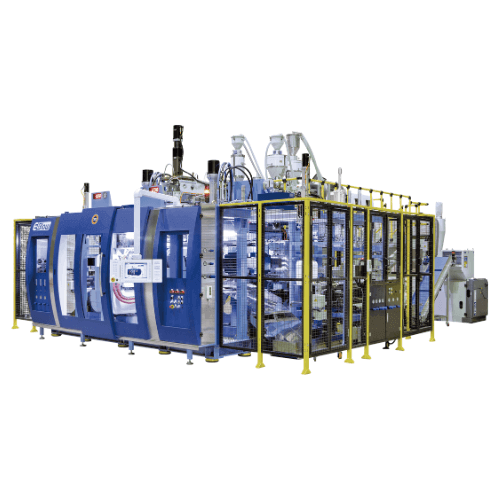
Sample photo of Extrusion Blow Molding Machine (Fong Kee - FKI)
Because an EBM parison is just a tube waiting to be shaped, it's the process to reach for whenever the container isn't a simple round bottle. Detergent bottles with off-center handles, automotive ducts and fluid reservoirs, fuel tanks, industrial drums, and multi-liter jerry cans are all EBM territory, shapes that would be impossible or absurdly expensive to injection mold first. EBM machines are also generally cheaper to tool up for short runs and prototypes than IBM or ISBM, which is why it remains the most widely used blow molding process by machine count.
The tradeoff is control: because the parison hangs and stretches under its own weight before the mold closes, wall thickness is naturally less uniform than in an injection-based process, unless the machine has parison programming to vary the die gap during extrusion. EBM also requires more downstream finishing. Trimming flash from the pinch points, that injection-based processes skip entirely.
Where Injection & Stretch Blow Molding Win
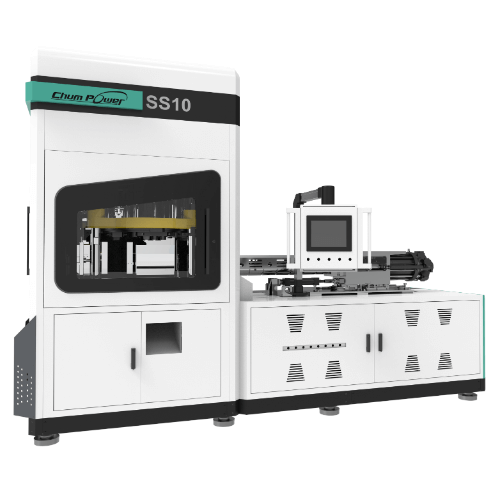
Sample photo of Injection Stretch Blow Molding Machine (CHUMPOWER)
Injection blow molding exists for one reason: the neck. Because the preform's neck and thread are injection molded to exact spec from the start, IBM produces containers with finished, precision necks straight off the machine. No post-trim needed, which is exactly what pharmaceutical vials, cosmetic bottles, and small specialty containers need. Its ceiling is size: preform injection capacity makes it impractical much past 300 mL, and it can't produce handled or flat bottles.
Stretch blow molding takes that same injection-molded preform and adds the one step that makes PET beverage packaging possible: axial stretching before the blow. That biaxial orientation is what lets a PET bottle hold carbonation pressure without bulging, stay optically clear, and use noticeably less material than a straight-blown container of the same size, which is why virtually every soda, water, and juice bottle on a store shelf is made this way. The cost is upfront: stretch blow tooling and the stretch mechanism itself make ISBM machines the most expensive of the three to acquire, which is why the economics only make sense at real production volume.
How to Choose the Right Blow Molding Process
Three questions usually settle it:
Does the container need a handle, an offset neck, or an irregular shape?
- Extrusion blow molding is the only process built for that.
Does the product need to hold carbonation, or does clarity and strength matter more than shape freedom?
- Injection stretch blow molding is built specifically for that.
Is it a small, simple bottle where a precision neck matters more than production volume?
- Injection blow molding is usually the most cost-effective route.
Many packaging lines run more than one type side by side — an EBM machine for a handled detergent jug, and an ISBM machine down the same production floor for the smaller companion bottle in the same product line.
Top 5 Extrusion Blow Molding Machine Manufacturers
1. Kautex Maschinenbau — Germany
Founded in 1935 in Bonn and now part of China's Jwell Machinery Group following a 2023 restructuring, Kautex built its name on large-scale extrusion blow molding for automotive fuel tanks and industrial packaging, running its KBS, KBB, and KEB machine series across consumer packaging, industrial containers, and automotive applications. It remains one of the deepest technical benches in large-tonnage EBM anywhere in the world.
2. BEKUM Maschinenfabriken — Germany
Founded in 1959 in Berlin, BEKUM has delivered more than 16,000 blow molding machines worldwide and holds a string of industry firsts to its name, including the world's first double-station blow molding machine in 1963 and the first six-layer coextrusion blow molding machine in 1976. Large blow molders are built at its Traismauer, Austria site, with packaging-scale machines built in Berlin.
3. Fong Kee International (FKI) — Taiwan
Founded in 1953 by C.C. Wei, FKI is one of Taiwan's longest-running plastic extrusion machinery builders, with a product range spanning blow molding, blown film, cast film, sheet extrusion, and lamination lines sold to more than 100 countries. Its Taiwan Excellence Award-winning iBlow all-electric blow molding line adds auto-deflashing, robotic part removal, and automated defect detection to standard bottle production runs.
4. Kai Mei — Taiwan
A Taichung-based extrusion blow molding specialist with decades in large-container and heavy-duty work, Kai Mei's PBI and PBL series are built for toolboxes, 15–60 liter containers, and ultra-high-molecular-weight chemical drums up to 200 liters. Its PBI-905 machines produced the folding stadium seats for three FIFA World Cup tournaments — Japan/Korea 2002, Brazil 2014, and Russia 2018 — a rare public benchmark for large-part precision and duty-cycle reliability in EBM equipment.
5. Parker Plastic Machinery — Taiwan
Founded in 1989 in Taichung, Parker is a full-range Taiwanese blow molding builder offering extrusion, injection, and stretch blow molding machines as turnkey solutions, with capacities spanning 20cc up to 200-liter containers, including multi-layer co-extrusion machines for 1–30 liter barrier containers. Parker pairs its machinery with pre-sales project studies and ongoing training and service support for buyers setting up a new production line.
Top 5 Injection & Stretch Blow Molding Machine Manufacturers
1. Nissei ASB — Japan
Founded in 1978 in Sakaki, Nagano, Nissei ASB is the original developer of the one-step injection stretch blow molding process and still holds the world's leading share of one-step ISBM machines, with more than 5,000 machines and 10,000 molds delivered to around 100 countries. Its ASB series covers production from 50 to 20,000 bottles per hour in a footprint far smaller than an equivalent two-stage line.
2. Krones — Germany
Founded in 1951 in Neutraubling and still one of the largest full-line beverage packaging suppliers in the world, Krones entered PET stretch blow molding in 1997 with its Contiform series, which now runs up to 100,000 bottles per hour for containers up to 3.5 liters. Krones typically sells stretch blow molding as one module inside a complete bottling line, alongside its own filling, labeling, and capping equipment.
3. Sidel — France
Founded in 1965 in Le Havre and part of the Tetra Laval Group since 2003, Sidel delivered its first PET blow molding machine in 1980 and its first high-speed PET blow molding machine in 1984, and now has more than 40,000 machines installed in over 190 countries. Its SBO series remains one of the most widely deployed two-stage stretch blow platforms in large-scale beverage bottling worldwide.
4. Chumpower Machinery — Taiwan
Founded in 1981 in Taichung and originally a chuck-tool manufacturer, Chumpower moved into stretch blow molding machinery in 1994 and now accounts for roughly 85% of Taiwan's PET blow molding machine exports, with more than 3,000 machines sold to 103 countries. It ranks among the largest two-step PET blow molding machine manufacturers in the Asia-Pacific region, and its BottleViewer system adds real-time production monitoring and predictive maintenance to standard bottling lines.
5. Full Shine Plastic Machinery — Taiwan
Founded in 1992 in Taichung, Full Shine builds automatic blow molding machines, PET stretch blow molding machines, and one-step injection blow molding machines covering an unusually wide capacity range — from 5 mL up to 500-liter containers on a single product line. The company won Taiwan's Golden Hand Award in 2006 for its co-extrusion technology and holds ISO 9001 and CE certification across its equipment.
Frequently Asked Questions
What are the three main types of blow molding?
Extrusion blow molding (EBM), injection blow molding (IBM), and injection stretch blow molding (ISBM). EBM starts from an extruded tube and offers the most shape freedom; IBM and ISBM both start from an injection molded preform, with ISBM adding an axial stretch step for strength and clarity.
Why do PET soda bottles need stretch blow molding instead of regular blow molding?
Stretching the preform biaxially before blowing aligns the plastic molecules in two directions instead of one, which is what gives PET bottles the strength to hold carbonation pressure, the clarity for retail shelves, and better resistance to gas permeation than a straight-blown bottle of the same weight.
Can extrusion blow molding make bottles with handles?
Yes — handled containers, offset necks, and irregular shapes are exactly where extrusion blow molding has an advantage over injection-based processes, since the parison is a plain extruded tube rather than a pre-shaped preform locked to a round profile.
Whether your production line needs the shape freedom of extrusion blow molding or the precision and strength of injection stretch blow molding, PRM-Taiwan connects buyers directly with the manufacturers behind both — browse our Blow Molding Machines category to compare suppliers directly.
We have over 200 of the biggest and many of the smallest Taiwanese machinery manufacturers on our site and contacts with many more. Whether you are looking for full lines such as, recycling machines extruders, blow molding machines, injection molding machines and printing machines, or auxiliary equipment and parts such as gearboxes, barrels, screws, molds, dies, control systems and virtually anything related to the plastic and rubber industries including packaging. If it’s made in Taiwan, we will find it for you!