English - EN
 繁體 - ZH-TW
 简体 - ZH-CN
 Español - ES
 日本語 - JA
 العربية - AR
 Русский - RU
 Français - FR

Why Some Laundry Pods Don’t Dissolve: The Plastic Science Behind PVA Film
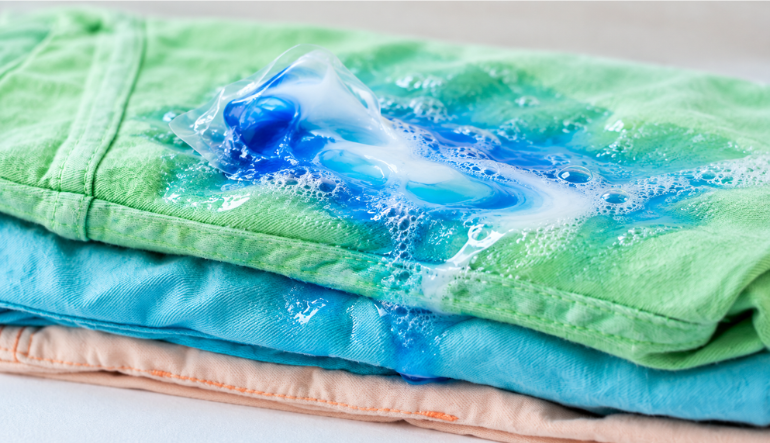
You’ve probably been there. You toss a load of laundry into the washer, drop a pod on top, press start, and walk away. A couple of hours later you open the door and find the pod still there, half-dissolved, a slimy blob glued to your favorite shirt, with a streak of blue gel smeared across the rest of the load.
So you run the whole thing again and wonder: isn’t the pod supposed to just disappear?
It’s supposed to. The thin film wrapped around every pod is a small piece of engineering. It has to hold concentrated detergent for months on a shelf, survive being grabbed with damp hands, and then vanish completely in a cold wash, all without you ever thinking about it. When a pod ends up stuck to your clothes, one of those jobs has failed. Sometimes it’s how the pod was used. Sometimes it’s the plastic itself.
Here’s what that film is made of, why it sometimes refuses to dissolve, and how it gets made in the first place.
What the film is
The film around detergent pods is made from polyvinyl alcohol (PVA or PVOH), designed to dissolve completely in water. PVOH is generally made by hydrolysis of polyvinyl acetate, and the most important number in the whole process is the degree of hydrolysis (DH): the share of acetate groups that get converted into hydroxyl (–OH) groups.
That number decides how the film behaves in water. Hydroxyl groups attract water, but they also form hydrogen bonds with each other. Those bonds let the polymer chains pack tightly into crystals that water has a hard time breaking into. Leaving some acetate groups in place breaks up that packing. When enough acetate groups remain, the polymer is more weakly hydrogen-bonded, less crystalline, and generally soluble in cold water below about 50°F.
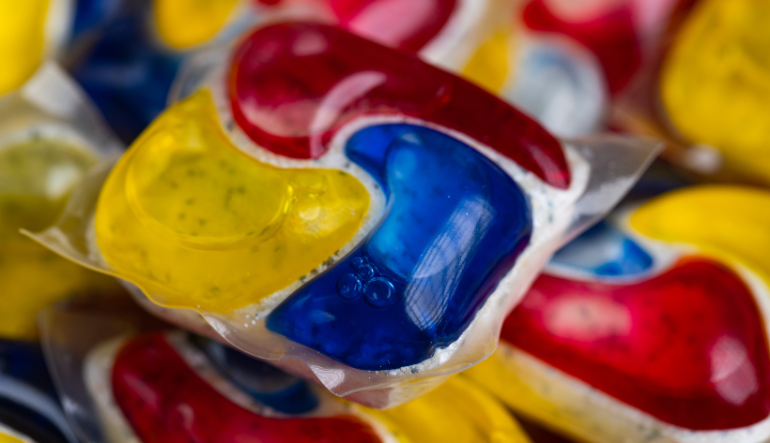
In practice, a cold-water-soluble film (below 10°C) uses PVOH with a DH of roughly 75–90%, a DH of 94–98% dissolves readily only in warm water around 40°C, and a DH of at least 98% needs water of about 60°C or more. An 88% hydrolyzed grade is especially common for water-soluble packaging.
Two other ingredients matter. Glycerin is a well-established plasticizer for PVOH, keeping the film soft enough to form and seal. And the detergent inside is not the same as bottled liquid detergent: commercial pods typically contain low-water formulas, because the film itself is water soluble.
Why some pods don’t dissolve
1. The film changes in storage.
This is the least obvious cause, and the one film makers worry about most. Film made from partially hydrolyzed PVOH is sensitive to high- or low-pH chemicals, which hydrolyze the remaining vinyl acetate and turn the film into cold-water-insoluble PVOH. Liquid laundry detergent is alkaline, and it sits against the film from the day the pod is filled until the day it’s used. Over months, the film can gradually turn into a warm-water grade. An old pod may fail in the same cold wash that a fresh pod handles without trouble.
Film makers counter this by adding other building blocks to the polymer. In one patent, a film with at least 4 mol% itaconic acid kept good solubility after prolonged contact with liquid laundry detergent, while a film with 2.8% did not. The gap between those two figures shows how narrow the margin is. Two pods that look identical on the shelf can behave very differently after six months.
2. The film overheated during production.
Applying more heat during film production increases the crystalline content and tends to reduce the film’s water solubility. A film produced with poor temperature control can start its life less soluble than its formula says it should be.
3. The wash works against the pod.
Even a good film needs water and movement. Very cold water, short quick-wash cycles, an overloaded drum, or a pod placed on top of the clothes instead of at the bottom of the drum can all leave it trapped in a fold of fabric. There it softens into a gel instead of dissolving.
Why pods stick together
PVA absorbs moisture from the air. In a humid laundry room, or when grabbed with wet hands, the film surface starts to dissolve and turns tacky, and pods that touch can fuse into a single block. That’s why packs tell you to keep the lid closed and handle pods with dry hands. Film developers treat it as a real design problem; one patent highlights a multilayer structure whose pouches are not tacky to the wet hand.
Does the film become microplastic?
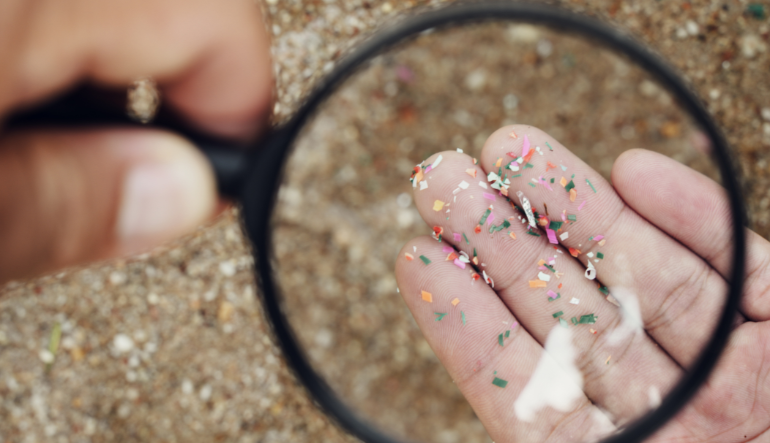
According to the American Cleaning Institute, the film is highly water soluble, including in cold water, because it must fully dissolve. The institute also stresses that the PVOH used in fishing lines is a different, more hydrolyzed type than the PVOH used in detergent films. The PVA name covers many grades, and they don’t all behave the same.
How PVA film is made: casting vs. blown film
There are two main routes: casting vs. blown film. In solution casting, PVA resins are dissolved in water with additives, and the solution is cast through a coat hanger die or in front of a doctor blade to form a layer of consistent thickness. In melt extrusion, pelletized, pre-dried, melt-processable PVA resin is fed into a film extruder, using a circular die for blown film or a coat hanger die for cast film.
Casting has long been the standard for pod film. Casting is often preferred for its accuracy in film thickness. Blown film offers a different set of advantages. Extrusion doesn’t require water to be added and removed during the process, and it is generally quicker than solution casting, so more film can be produced at the same time. Stretching during blown film extrusion and wind-up also orients the film, greatly increasing tear strength, an advantage that solvent casting can’t provide.
There are trade-offs. Solution-cast film dissolves more easily and seals better than extruded film, and some components that would decompose at extrusion temperatures can only go into cast film.
That means a PVA blown film line is not just a standard PE line running a different resin. If you’re evaluating one, focus on three things:
- Precise temperature control along the barrel and die. Excess heat raises crystallinity and can degrade additives.
- Reliable pellet drying upstream.
- Tight gauge control. Film thickness directly affects how fast the pod dissolves.
Find a PVA Film Blown Extruder on PRM
Everything above comes back to the machine. A pod that dissolves cleanly in a cold wash, six months after it was made, starts with a film that leaves the die with the right crystallinity, an even thickness, and no damage from heat along the way. PVA is a hard resin to run, because it reacts to heat, moisture, and shear all at once. A line built mainly for PE can run it, but not always well, so the real question to ask a manufacturer is how much PVA experience they have, and whether they’ll run a trial with your resin before you commit.
If you’re planning or upgrading a water-soluble film line, PRM-Taiwan.com is a good place to start. You can browse Top blown film extruder manufacturers in one place, compare what they offer, and send your inquiry directly to the ones that fit your project. Tell them up front that you’re processing PVA and ask for trial results, and you’ll quickly see who has done it before.
We have over 200 of the biggest and many of the smallest Taiwanese machinery manufacturers on our site and contacts with many more. Whether you are looking for full lines such as, recycling machines extruders, blow molding machines, injection molding machines and printing machines, or auxiliary equipment and parts such as gearboxes, barrels, screws, molds, dies, control systems and virtually anything related to the plastic and rubber industries including packaging. If it’s made in Taiwan, we will find it for you!