

 English - EN
  繁體 - ZH-TW
  简体 - ZH-CN
  Español - ES
  日本語 - JA
  العربية - AR
  Русский - RU
  Français - FR
US Tariff Uncertainty Sparks "Wait-and-See" Approach in Plastics CapEx: A Turning Point for Sourcing?
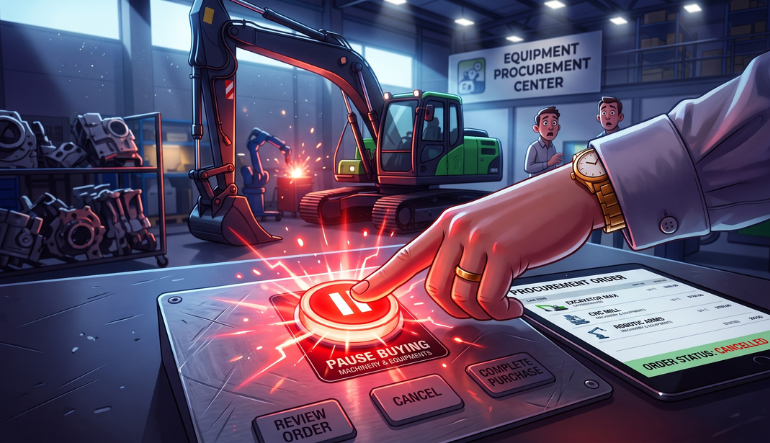
The North American plastics processing industry is facing a turbulent third quarter. Following the Supreme Court's February 2026 ruling against IEEPA-based tariffs, the activation of Section 338 tariff authority against Canada, and an unresolved USMCA review, a thick fog of uncertainty has settled over the manufacturing sector.
For plastics processing executives, the message is clear: the cost of importing high-end injection molding machines and precision molds is climbing, prompting a massive wave of delayed Capital Expenditures (CapEx).
The 2026 Tariff Wave: Section 338 and the USMCA Review
The disruption escalated on July 20, 2026, when the US government invoked Section 338 of the Tariff Act of 1930 — a retaliatory-tariff authority essentially dormant since the 1930s and never before used to impose duties — to place a sweeping new 50% tariff on a wide range of Canadian imports, effective August 19, 2026. The move came in response to Canadian measures the administration deemed discriminatory toward US motor vehicles.
This followed a separate, already-expired chapter of tariff turbulence: a temporary 10% global surcharge invoked in February 2026 under Section 122 of the Trade Act of 1974 (capped by law at 15% and 150 days), which lapsed in July 2026 after the Supreme Court's ruling in Learning Resources, Inc. v. Trump struck down the administration's broader IEEPA tariff program and pushed it toward these alternative authorities.
Interestingly, the Plastics Industry Association (PLASTICS) itself struck a measured tone on the Canada tariffs. Because the US runs roughly a $1.55 billion plastics trade surplus with Canada and maintains substantial domestic machinery and mold-making capacity, PLASTICS Chief Economist Perc Pineda concluded that "the risk of broad supply disruptions appears limited." Imported plastics machinery, he noted, "complements" rather than replaces US domestic production. The bigger issue PLASTICS has flagged isn't the Canada tariff itself — it's planning uncertainty: equipment buyers now face a moving target, with only temporary Section 232 relief on some machinery running through December 2027.
Layered on top of that is the USMCA review, which is no longer "looming" — it already began. When the joint review opened on July 1, 2026, USTR Ambassador Jamieson Greer stated the US "did not agree to renew the USMCA in its current form," triggering an ongoing annual-review process even as the agreement itself remains legally in force through 2036. For manufacturers, that's arguably the harder problem: not a single new tariff, but an open-ended renegotiation with no fixed resolution date.
Europe's "Existential Threat" is North America's CapEx Freeze
This North American uncertainty is compounding an already strained global procurement landscape. In August 2025, after the administration expanded Section 232 tariffs to cover imported molds and plastics machinery components — adding a 50% duty on their metal content — the Mechanical Engineering Industry Association (VDMA), which represents roughly 3,600 German machinery manufacturers, issued a stark warning. VDMA President Bertram Kawlath wrote to European Commission President Ursula von der Leyen that the tariffs were "sending key machinery sectors hurtling toward the precipice of an existential crisis."

That expansion wasn't a one-time shock. An April 2026 proclamation restructured Section 232 duties onto a full-customs-value basis, with tiers reaching 50% on steel/aluminum content, 25% on general industrial content, and 15% on electrical equipment. For buyers in the US and Mexico, the math has been deteriorating for over a year: tariff exposure at these levels stretches ROI timelines to the breaking point, forcing many facility managers to hit pause on premium European equipment purchases.
The Pivot to Lean Manufacturing & Strategic Sourcing
With 2025's tariff expansions and 2026's new trade mechanisms functioning as a de facto ongoing tax on imported resins, machinery, and molds, processors are being forced to pivot. Industry consultants specializing in operational excellence increasingly advise against rushing into high-cost overseas equipment purchases amid this volatility — pointing instead toward lean manufacturing and maximizing the Overall Equipment Effectiveness (OEE) of existing lines as the lower-risk near-term move.
When new CapEx is unavoidable, buyers are actively diversifying supply chains away from high-tariff zones. This presents a real opportunity for reliable, agile manufacturing hubs like Taiwan, long recognized for its plastics machinery and precision mold-making capabilities and increasingly investing in Smart Factory integration. That said, Taiwan-origin equipment isn't automatically outside the tariff net — Section 232 derivative and reciprocal duties can still apply depending on HTS classification — so buyers should verify landed cost and classification before assuming a sourcing switch sidesteps tariff exposure entirely.
Explore PRM's Taiwan Supplier Directory to find your destined suppliers!
Sources:
- PLASTICS: Trump Administration Imposes 50% Tariffs on Canadian Plastics to Counter Discriminatory Measures
- PLASTICS: A Conversation on Navigating the Future of Trade with Dr. Robert Koopman, Former Chief Economist of the World Trade Organization
- PlasticsToday: Trump's Canadian Plastics Tariffs Face Limited Supply Disruption
- White & Case: USMCA 2026 Joint Review: United States declines to extend Agreement, triggering annual reviews
- Morrison Foerster: Revival of a Dormant Tariff Authority: Section 338
This market insight was co-piloted by AI and strictly curated by the PRM editorial team to ensure accuracy and high-value intelligence for our global buyers.
We have over 200 of the biggest and many of the smallest Taiwanese machinery manufacturers on our site and contacts with many more. Whether you are looking for full lines such as, recycling machines extruders, blow molding machines, injection molding machines and printing machines, or auxiliary equipment and parts such as gearboxes, barrels, screws, molds, dies, control systems and virtually anything related to the plastic and rubber industries including packaging. If it’s made in Taiwan, we will find it for you!