English - EN
 繁體 - ZH-TW
 简体 - ZH-CN
 Español - ES
 日本語 - JA
 العربية - AR
 Русский - RU
 Français - FR

Top 10 Blown Film Extruder Machine Manufacturers in 2027
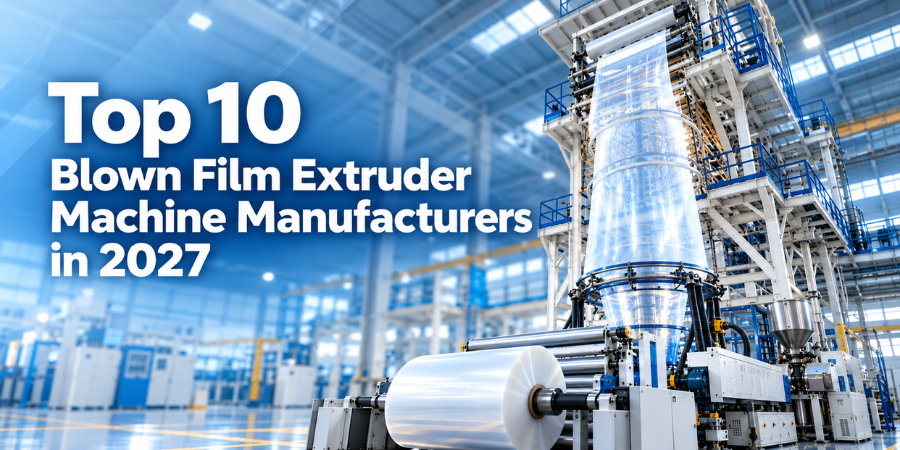
Almost every plastic bag, shrink wrap, stretch film, agricultural mulch film, and food packaging pouch you have ever touched started life the same way: as a bubble. A blown film extruder melts plastic resin, pushes it up through a ring-shaped die, and inflates it with air into a tall, thin-walled tube that is cooled, flattened, and wound onto rolls. It is one of the highest-volume processes in the entire plastics industry, and the machine behind it decides how thin, how strong, how clear, and how consistent that film can be.
Choosing a blown film extruder is therefore a long-term decision about film quality, output, and operating cost, not just a machine purchase. This guide explains the key technical choices behind a blown film line, then introduces the ten blown film extruder machine manufacturers buyers should know in 2027, from the European technology leaders to the Asian builders that dominate mid-range and high-value production.
How a Blown Film Extruder Works
A blown film line has five core sections. The extruder melts and pressurizes the resin with a rotating screw. The annular die shapes the melt into a continuous tube. Air is introduced through the die center to inflate that tube into a bubble, while an air ring (and on many modern lines, internal bubble cooling, or IBC) cools it from outside and inside. At the top of the tower, nip rolls collapse the bubble into a flat double layer, which is then trimmed, slit, or gusseted and taken up by the winder.
Two numbers control most of the film's properties. The blow-up ratio (bubble diameter divided by die diameter) sets how much the film is stretched sideways, and the draw-down ratio sets how much it is stretched lengthwise. Balancing the two is what gives blown film its strength in both directions, which is the main reason it is preferred over cast film for bags, heavy-duty sacks, and agricultural film.
Mono-layer vs. Multi-layer Co-extrusion
The single biggest decision when buying a blown film extruder is how many layers it produces. A mono-layer line uses one extruder and is the economical choice for shopping bags, garbage bags, and general-purpose HDPE, LDPE, or LLDPE film. Co-extrusion lines feed several extruders into one multi-layer die, so each layer can do a different job: a cheap recycled or filled core, a sealable inner skin, and a printable outer skin, or a barrier layer such as EVOH or PA sandwiched inside polyethylene.
| Mono-layer | 3-layer (ABA / ABC) | 5 to 11-layer | |
| Typical films | Shopping bags, garbage bags, simple liners | Shrink film, heavy-duty sacks, agricultural film, cost-down films with recycled core | High-barrier food packaging, vacuum and skin packaging, medical and technical films |
| Barrier capability | Low | Moderate | High (EVOH, PA layers) |
| Investment | Lowest | Medium | Highest |
| Main advantage | Simple to run and maintain | Lower material cost per kilogram of film | Thinner films with engineered performance |
What to Look for in a Blown Film Line
Thickness control:
automatic die or air-ring profile control and an oscillating haul-off spread thickness variation evenly across the roll, which matters most for printing and lamination.
Cooling capacity:
output is usually limited by how fast the bubble can be cooled, so IBC and the air-ring design directly affect kilograms per hour.
Recycled-content readiness:
inline edge-trim recycling and stable processing of recycled resin are now baseline requirements for packaging film producers.
Automation and service:
gravimetric dosing, automatic roll changes, and remote diagnostics reduce labor and downtime, but only if the supplier can support the line in your region.
Top 10 Blown Film Extruder Machine Manufacturers in 2027
1. Windmöller & Hölscher (W&H) — Germany
Headquartered in Lengerich since its founding in 1869, family-owned W&H is a world leader in flexible packaging machinery covering film extrusion, printing, and converting, and has built blown film lines since 1967. Its VAREX II platform is the benchmark for customized, high-output blown film production, and W&H machines are in use by more than 5,000 customers in over 130 countries. Its ability to supply extrusion, printing, and bag converting from a single source makes it a natural choice for large packaging groups.
2. Reifenhäuser Blown Film — Germany

Part of the family-owned Reifenhäuser Group of Troisdorf, one of the largest extrusion technology networks in the world, Reifenhäuser Blown Film grew from the 2009 acquisition of Kiefel Extrusion and consolidated its blown film units under one brand in 2021. Its EVO GEN3 generation of blown film lines focuses on smart assistance systems and automation that raise throughput and help processors keep production know-how in-house despite staff turnover.
3. Hosokawa Alpine — Germany
Based in Augsburg and part of Japan's Hosokawa Micron Group, Hosokawa Alpine has more than 125 years of engineering history and is known in blown film for its X-Die and for lines ranging from mono-layer to 11-layer barrier and MDO (machine-direction orientation) configurations. Recent developments such as camera-based bubble contour detection let processors save and automatically recall an optimal bubble geometry when changing products or restarting production.
4. Macchi — Italy
Founded in 1961, Macchi was one of the first equipment manufacturers in the world to concentrate entirely on blown film extrusion, and today offers one of the largest and most diversified blown film programs in the industry, from standard packaging lines to multi-layer barrier and technical film lines.
5. Jinming Machinery — China
Founded in 1987 in Shantou and listed on the Shenzhen Stock Exchange since 2011, Guangdong Jinming Machinery is one of Asia's largest film extrusion equipment makers, building blown film, cast film, film orientation, and lamination lines sold to around 50 countries. Its blown film range covers 3 and 5-layer stretch film lines, heavy-duty and FFS film lines, agricultural film lines, and 5 to 11-layer high-barrier film lines for food and medical packaging.
6. Kung Hsing Plastic Machinery — Taiwan
With more than 50 years of experience in plastic extrusion machinery, Kung Hsing is one of Taiwan's most active blown film builders, producing around 200 blown film machines a year for customers in more than 130 countries. Its range runs from mono-layer machines to 3 to 7-layer co-extrusion lines that process virgin, recycled, and biodegradable materials for food packaging, agricultural film, and heat shrink film. A third plant completed in 2022, with 36-meter ceilings and 6,600 square meters of floor space, supports its push into wider agricultural film and geomembrane lines.
7. Bandera — Italy
Officially registered by Luigi Bandera in 1947, with its earliest blown film die drawings dating to 1952, Costruzioni Meccaniche Luigi Bandera designs mono and multi-layer blown film lines for technical and packaging films. Its dedicated high-output lines for shrink film and pallet covers are well regarded among producers of industrial packaging film.
8. Kang Chyau Industry — Taiwan
Founded in 1988 in New Taipei City, Kang Chyau is one of Taiwan's top three blown film machine exporters, with more than 8,000 machines sold across 62 countries and regions. Its range covers high-speed HDPE, LDPE, and LLDPE inflation machines, twin-head lines, two-layer and three-layer ABA lines, and PP blown film machines, plus whole-plant plastic bag equipment. Its three-layer lines are widely used to run a recycled or filled core between virgin skins to cut material cost, and it has extended its PLA biodegradable film lines to 1-meter film widths.
9. Chyi Yang Industrial — Taiwan
Established in 1965, Chyi Yang is one of Taiwan's most experienced blown film machine builders, specializing in 3, 5, and 7-layer co-extrusion lines for shrink film, agricultural film, barrier food packaging, vacuum skin packaging, and medical film. Its lines process HDPE, LDPE, LLDPE, EVA, PP, EVOH, and PA, and combine IBC cooling, intelligent formula calculation, a patented automatic front-cut winder, and inline waste-film recycling. Chyi Yang is also a leading supplier of PE stretch and cling film blown film machines.
10. Macro Engineering & Technology — Canada
Founded in 1978 near Toronto by chemical engineer Mirek Planeta, Macro began by improving air-ring design, a focus that led to the invention of the dual-lip air ring now standard across the industry. It has since grown from a component supplier into a builder of complete blown film, cast film, and sheet extrusion systems, including multi-layer barrier lines.
Honourable Mentions
ShengPlas — Taiwan
ShengPlas (Shenghong) carries forward the blown film business of Queen's Machinery, a name that shaped Taiwan's blown film industry for decades. Queen's was once described as the world's largest producer of film-blowing machines by unit volume, exported thousands of its EP50N HDPE bag film machines, and was among the first in Taiwan to develop five-layer blown film structures with nylon barrier layers and a shorter oscillating tower for low-ceiling factories. Shenghong builds on that engineering base for bag film and multi-layer packaging film production.
Plastar Machinery — China
Founded in 2008 in Rui'an, Zhejiang, one of China's main packaging machinery hubs, Zhejiang Pengxiang (Plastar) focuses on multi-layer co-extrusion blown film machines with internal bubble cooling, as well as stretch film machines, exported to Europe, the Middle East, South Asia, Turkey, and Mexico. Its modular three-layer high-speed lines combine customized die heads and winders with AI-driven automation that holds film thickness uniformity to about ±1.5%, a configuration it has demonstrated at the K Show in Düsseldorf.
Frequently Asked Questions
What is the difference between blown film and cast film?
Blown film is extruded as a tube and inflated, so it is stretched in both directions and has balanced strength, which suits bags, sacks, and agricultural film. Cast film is extruded flat onto a chill roll, giving better clarity, gauge uniformity, and higher line speeds, which suits stretch wrap and some laminating films.
How many layers does a blown film machine need?
For shopping and garbage bags, a mono-layer or ABA three-layer line is usually enough. Shrink film and heavy-duty sacks benefit from three layers, while food packaging that needs an oxygen or moisture barrier typically requires five, seven, or more layers.
Which materials can a blown film extruder process?
Polyethylene (HDPE, LDPE, LLDPE, mLLDPE) is the main material. Depending on the line, blown film extruders also process PP, EVA, EVOH, PA, and biodegradable resins such as PLA, as well as recycled PE.
Whether you need a high-output European line or a cost-effective, customizable blown film extruder from Asia, PRM-Taiwan connects buyers directly with the manufacturers behind them. Browse our Blown Film Machines category to compare suppliers and send inquiries directly.
We have over 200 of the biggest and many of the smallest Taiwanese machinery manufacturers on our site and contacts with many more. Whether you are looking for full lines such as, recycling machines extruders, blow molding machines, injection molding machines and printing machines, or auxiliary equipment and parts such as gearboxes, barrels, screws, molds, dies, control systems and virtually anything related to the plastic and rubber industries including packaging. If it’s made in Taiwan, we will find it for you!