English - EN
 繁體 - ZH-TW
 简体 - ZH-CN
 Español - ES
 日本語 - JA
 العربية - AR
 Русский - RU
 Français - FR

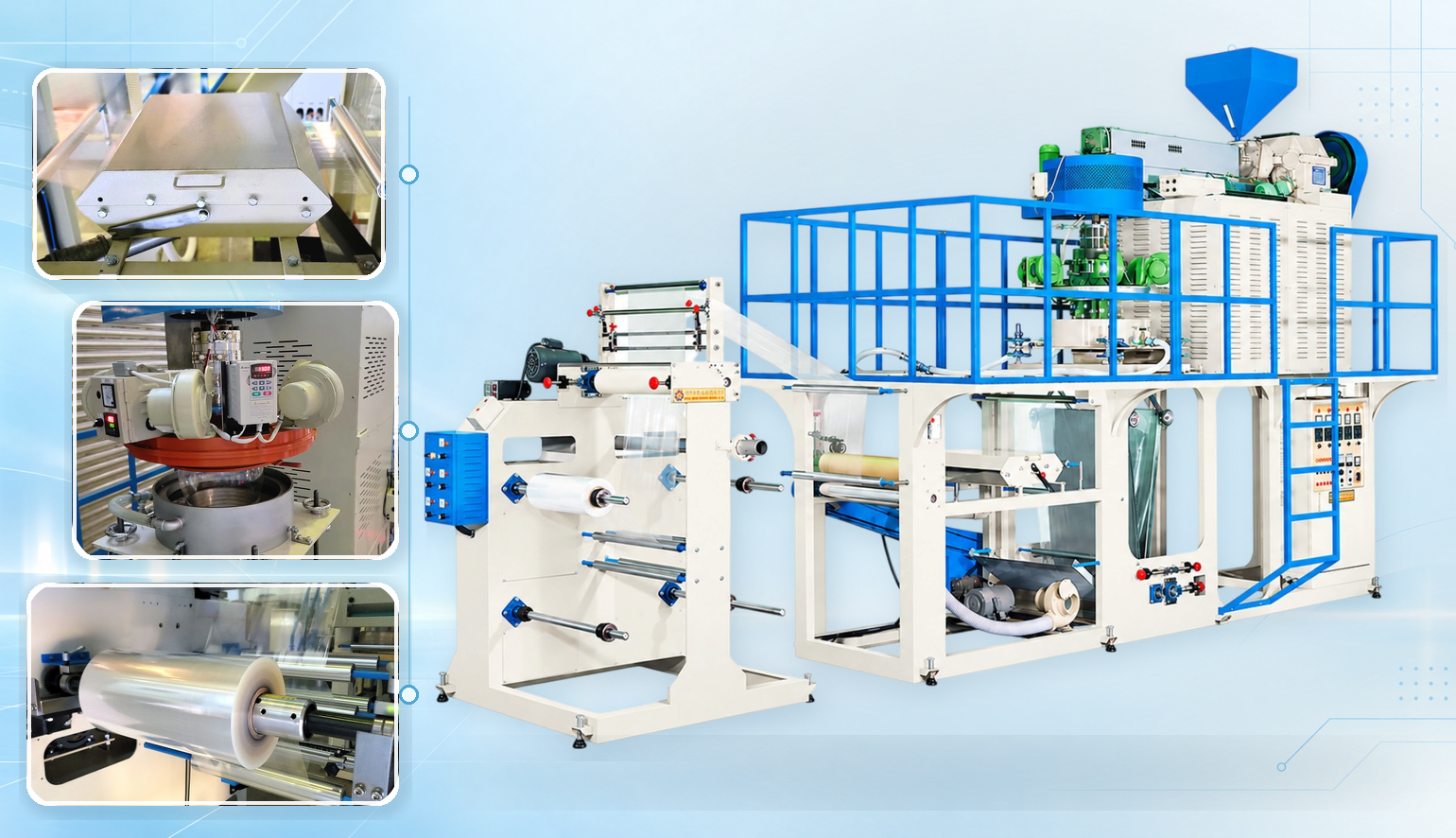
CHYI YANG PP Blown Film Machine: From Cooling to Winding
A PP film may look clear, yet water marks, gauge variations, or uneven winding during production can still affect the appearance of the finished packaging. These issues may also cause problems during unwinding, printing, or bag making.
To determine whether a blown film machine can meet specific production requirements, it is necessary to examine the entire process—from extrusion and water cooling to drying, winding, and downstream converting.
A Special Screw: PP Film Quality Starts With Plasticization
After the PP resin is heated and plasticized, the screw delivers the melt to the die head. Extrusion stability affects output as well as subsequent bubble formation and film quality.
The special screw design used in the CHYI YANG PP-Series is intended to increase output while minimizing output decline during extended operation. Stable plasticization and melt delivery allow the material to enter the die head under more consistent conditions, providing a reliable foundation for the subsequent downward extrusion and water-cooling process.
360° Rotary Die Head: Reducing Concentrated Gauge Bands
A slight thickness variation may occur at a particular position in blown film. It may be almost invisible in a single layer, but if the thicker area repeatedly lands in the same position during winding, the accumulated layers can form a raised gauge band.
The effect is similar to wrapping a bandage repeatedly around the same spot: that area gradually becomes thicker, and the overall shape of the roll becomes uneven.
The 360° Rotary Die Head continuously changes the position of these gauge variations. Instead of stacking in the same location in every layer, the thicker areas are distributed across the width of the roll, reducing the risk of concentrated gauge bands and helping produce a flatter film roll.
Downward Water Cooling: Clearer PP Film With Good Stiffness
PP is a semi-crystalline material. When the film bubble cools slowly after leaving the die head, larger crystalline structures have more time to develop, making the film more likely to appear hazy.
Conventional air-cooled blown film machines can also process PP. However, when an application requires lower haze and higher gloss, the cooling conditions immediately after extrusion become especially important.
The CHYI YANG PP-Series therefore combines Downward Extrusion with a water-cooling system. The PP melt is extruded downward from the die head, with gravity helping to guide and stabilize the film bubble. The bubble then passes directly through the Water Quench Ring.
The Water Quench Ring is designed to distribute cooling water around the circumference of the bubble and reduce uneven cooling. Because water removes heat more rapidly than air, the bubble can be quenched within a shorter period. This limits the time available for larger crystalline structures to develop, helping produce a smooth PP film with lower haze, higher gloss, and good transparency.
The film can also retain the stiffness required for many packaging applications. Once converted into bags, appropriate stiffness helps the package maintain its shape and supports subsequent feeding, opening, and sealing.
Flower bouquet sleeves are a clear example. After the film is wrapped around a bouquet, it needs to remain upright and open rather than collapsing or clinging tightly to the flowers. This helps preserve the bouquet’s original shape and visual presentation.
Drying and Winding: Preparing the Film Roll for Downstream Converting
Once the cooling water has completed its function, residual moisture must be removed from the film surface before winding.
If droplets or water marks remain on the film, the wound layers may stick together, causing blocking. Residual moisture may also interfere with corona treatment. The capacity of the Film Dryer Chamber must therefore be matched to the film width, film thickness, and production speed.
After drying, the film is guided to the winder and formed into a flat, uniform roll. Optional winding tension control can adjust the tension as the roll diameter increases, reducing the tendency of the film to become progressively tighter. This prepares the finished roll for subsequent unwinding, printing, and bag-making processes.
What Types of Clear PP Packaging Can Be Produced?
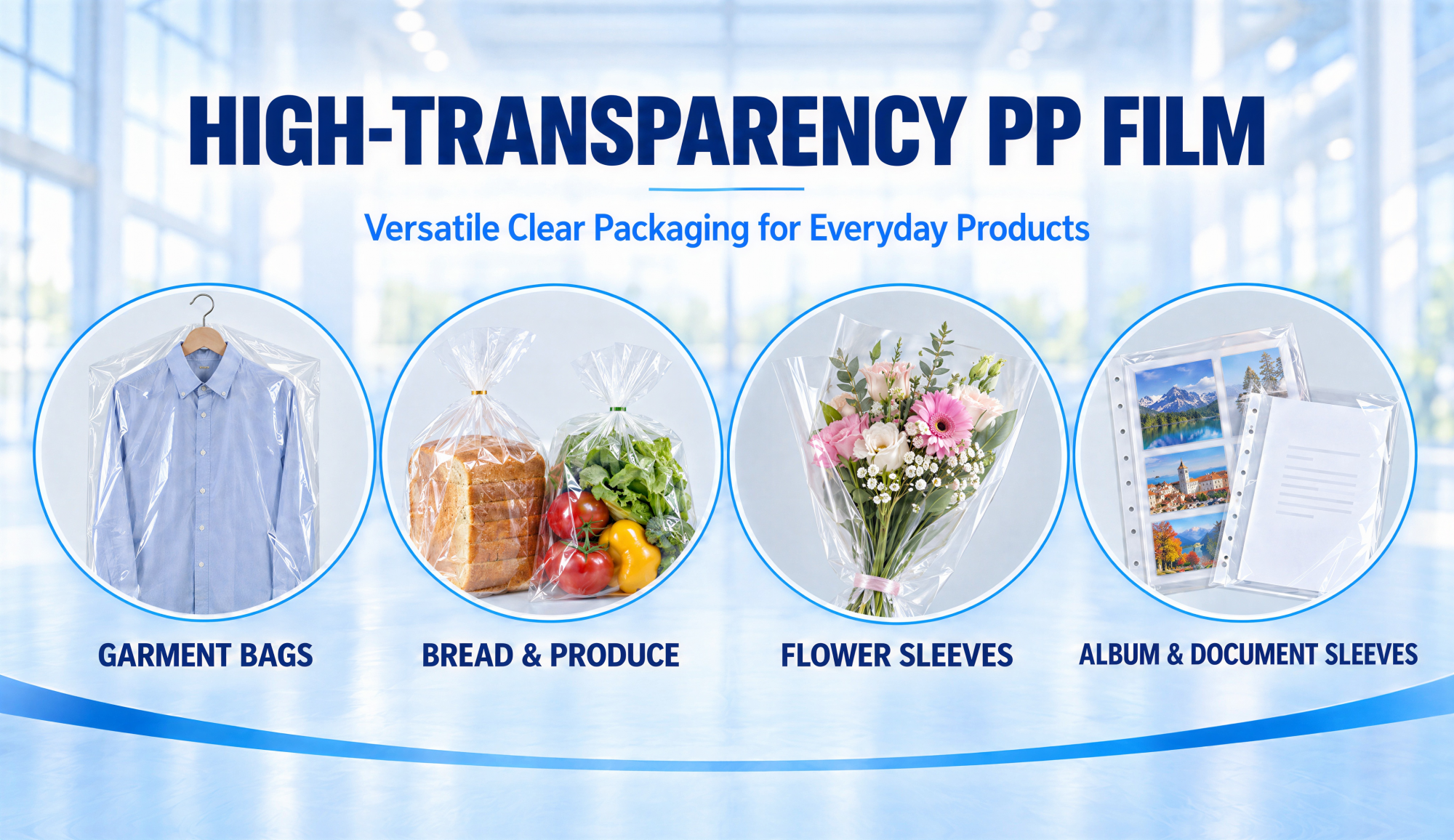
The PP Downward Water-Cooled Blown Film Machine can produce clear PP film for a variety of applications, including:
- Garment bags for shirts, knitwear, underwear, and other apparel
- Bread bags and selected fruit and vegetable packaging
- Clear flower bouquet sleeves for flowers and gifts
- Self-adhesive bags
- Photo album pages and document sleeves
These are common applications and do not represent the full range of products that can be produced on the machine.
For other clear PP film applications, customers may provide the intended resin, film width, film thickness, and end use for further evaluation of the machine configuration and trial conditions.
For food-contact applications, the PP resin, additives, and finished product must also be reviewed for compliance with the applicable food-contact regulations in the intended market.
Selecting the Appropriate Machine Model
CHYI YANG currently offers four standard models: PP-45H, PP-55H, PP-65H, and PP-75H. The appropriate model and configuration can be evaluated based on the product specifications and production requirements. Larger machine models are also available upon request.
| Model No. | Screw Diameter | Output | Roller Width | Die Diameter |
| PP-45H | 45 mm | 15–45 kg/h | 500 mm | 100 or 180 mm |
| PP-55H | 55 mm | 20–60 kg/h | 750 mm | 150 or 250 mm |
| PP-65H | 65 mm | 25–80 kg/h | 900 mm | 150 or 300 mm |
| PP-75H | 75 mm | 35–90 kg/h | 1,100 mm | 150 or 350 mm |
There Is No Universally Superior Process—Only the Process That Fits the Product
Machine selection should not be based solely on the model number or rated output. The raw material, product specifications, and downstream requirements—including printing and bag making—must all be considered.
Even among clear PP films, garment bags, bread bags, and flower bouquet sleeves require different film widths, thicknesses, stiffness levels, and converting conditions.
If you are planning a new clear PP film product—or if your application is not included among the common examples above—share your intended PP resin, film width, film thickness, target output, and end use with CHYI YANG.
The appropriate screw, die head, roller width, and winding configuration can then be evaluated according to the product requirements, followed by an actual material trial to confirm the performance of the finished film.

We, CHYI YANG INDUSTRIAL CO., LTD. were set up in 1965, are inseparably linked with the life and development of plastic machinery in Taiwan. The 2nd eldest producer of plastic machinery and holds the reputation of being a reliable business partner. Our immortal goal is to improve & upgrade ourselves continuously and endlessly and to achieve the level of technology and production management which will ensure high quality of all products and services. We do hope to attract and care for customers by following the fundamental principles such as correct and refined manners in business relations, as well as skilled, flexible and reasonable management, to create a new era in PLASTICS.