

 English - EN
  繁體 - ZH-TW
  简体 - ZH-CN
  Español - ES
  日本語 - JA
  العربية - AR
  Русский - RU
  Français - FR
The Future of Sustainable Packaging? Meet the "Living Plastic" That Self-Destructs in 6 Days
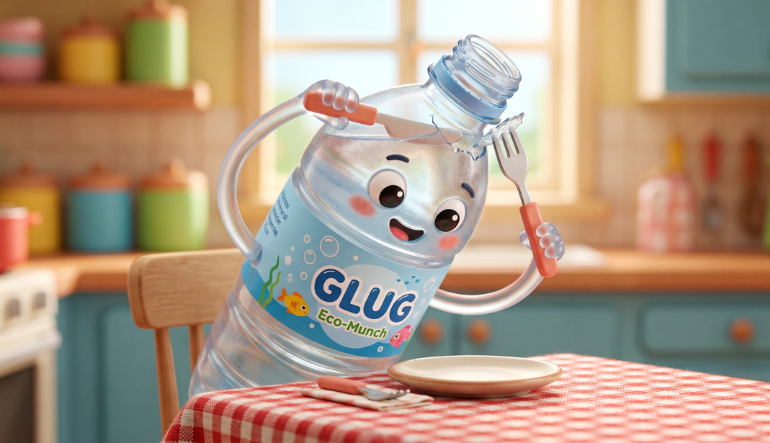
Think of it as a self-destruct sequence straight out of a spy movie, but for packaging.
For decades, the global plastics industry has faced a fundamental paradox: the very polymers we rely on for their durability and low cost often outlive their short-term applications by centuries. But what if we could program an expiration date directly into the material's life cycle? According to a study published in American Chemical Society (ACS), a new generation of "living plastic" might make this a reality.
Waking Up on Command
Researchers have successfully engineered a programmable plastic that effectively "comes alive" and destroys itself when triggered. The secret lies in incorporating dormant, engineered microbial spores (Bacillus subtilis) directly into the plastic—in this case, polycaprolactone (PCL), a biodegradable polyester commonly used in 3D printing and medical applications.
During its normal use, the living plastic behaves like a conventional polymer: it is strong, flexible, and stable. However, when exposed to a specific trigger—a warm nutrient broth heated to 50°C (122°F)—the dormant microbes wake up and get to work.
The Dual-Enzyme Tag Team: Zero Microplastics
Previous attempts to biologically break down plastics usually relied on a single enzyme, which was often slow and left behind problematic fragments. To supercharge the efficiency, the research team engineered the bacteria to produce two different polymer-degrading enzymes that work as a highly coordinated team.
The Chopper:
One enzyme randomly snips the long polymer chains into shorter pieces.
The Chewer:
The second enzyme immediately acts on those short pieces, chewing them down from the ends into their most basic monomer building blocks.
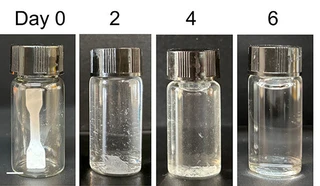
Powered by a coordinated pair of plastic-destroying enzymes, this innovative "living plastic" achieves complete degradation in just six days. Image by ACS, DOI: 10.1021/acsapm.5c04611
The result? Within just six days, the plastic material degrades entirely. Because the enzymes work so efficiently in sequence, the process leaves absolutely no microplastics behind.
What This Means for the Manufacturing Industry
For global buyers, packaging manufacturers, and R&D engineers, this represents a massive paradigm shift. Zhuojun Dai, a corresponding author of the study, noted that embedding these microbes turns durability from a stubborn environmental problem into a programmable feature. Hopefully, opening up a world of possibilities for short-lived products like agricultural mulch films or single-use compostable packaging.
However, while this "living plastic" represents an incredibly exciting leap forward for a greener environment and the future of alternative products, it isn't a magic bullet just yet. The self-destruct sequence currently relies on a very strictly controlled environment to activate. If a piece of this packaging ends up in a cold ocean or a standard landfill, those microbes will stay fast asleep, and the plastic will persist.
This reminds us of a crucial reality: as we engineer smarter materials, we cannot take our foot off the gas regarding physical waste management. We must continuously improve our mechanical and chemical recycling infrastructure. Innovations like living plastics are part of the solution, but ensuring that waste never leaks into our natural ecosystems and oceans in the first place remains our most critical line of defense.
As the industry pivots heavily toward sustainability and circular economy principles, the future of manufacturing isn't just about making materials smarter—it's about building robust recycling ecosystems to support them.
Stay tuned to PRM-Taiwan for more cutting-edge material innovations and smart manufacturing trends!
Source
- American Chemical Society: This ‘living plastic’ activates and self-destructs on command
- ScienceDaily: New “living plastic” self-destructs in just 6 days without leaving microplastics
We have over 200 of the biggest and many of the smallest Taiwanese machinery manufacturers on our site and contacts with many more. Whether you are looking for full lines such as, recycling machines extruders, blow molding machines, injection molding machines and printing machines, or auxiliary equipment and parts such as gearboxes, barrels, screws, molds, dies, control systems and virtually anything related to the plastic and rubber industries including packaging. If it’s made in Taiwan, we will find it for you!