

 English - EN
  繁體 - ZH-TW
  简体 - ZH-CN
  Español - ES
  日本語 - JA
  العربية - AR
  Русский - RU
  Français - FR
From Molecules to Money: How Molecular Marking Turns Plastic Waste into Digital Gold
The "Trust Gap" in recycling
In the global push for sustainability, one question haunts every purchase manager and brand owner: "Is this really recycled material, or is it just greenwashing?" As regulations in Europe and Singapore tighten, the industry is moving beyond simple claims. The future belongs to verified transparency. Today, we explore a groundbreaking shift where chemistry meets blockchain—transforming waste into tradable digital assets.
The Invisible Fingerprint: Molecular Marking Technology
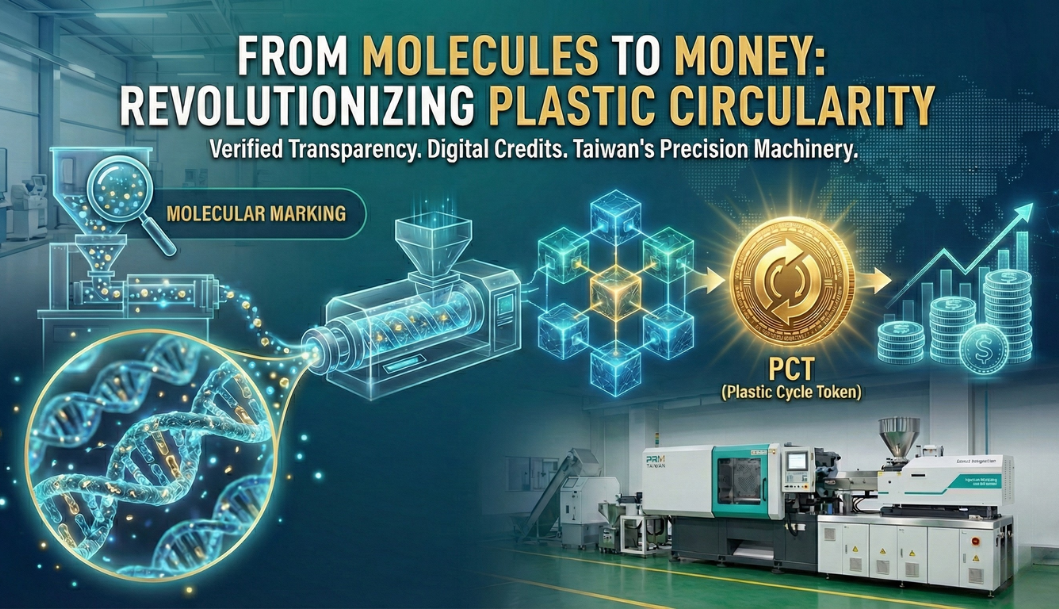
Imagine a barcode that is invisible to the naked eye, mixed directly into the raw material, and cannot be destroyed—even after melting, molding, and recycling. This is the real development of molecular marking technology. Innovators like SMX are leading the charge, developing markers that give plastics and rubber a unique "DNA." In fact, Singapore’s A*STAR has already partnered with SMX to build a national sourcing platform, proving it's the new infrastructure.
How Molecular Traceability Actually Works
It sounds like science fiction, but the technology is already here. Unlike QR codes that scratch off or paper labels that get lost, molecular marking works on a chemical level.
Here is the step-by-step breakdown of how this "invisible fingerprint" turns plastic into data:
- Step 1: The "Tagging" (Precision Dosing) A unique chemical marker is introduced into the raw polymer during the manufacturing process. This isn't just dumping additives; it requires high-precision dosing equipment to ensure the marker is evenly distributed (homogenized) throughout the material—often at a ratio as low as parts per million (ppm).
- Step 2: The "Survivor" (Processing Stability) The material enters the extruder or injection molding machine. The molecular marker is engineered to be thermally stable, surviving the high heat, shear force, and pressure of the production line without degrading. It becomes an intrinsic part of the product's DNA.
- Step 3: The "ID Check" (Instant Detection) Years later, when the product reaches a recycling facility, a handheld or inline spectral reader scans the plastic. It detects the invisible marker's unique signature instantly—no lab tests required.
- Step 4: The "Digital Twin" (Blockchain Verification) The reader sends the data to a blockchain ledger. This unalterable record confirms the material's origin, recycled content %, and loop count.

Turning Trash into Treasure: The Plastic Cycle Token (PCT)
Here is the game-changer for B2B businesses. Traceability is no longer just a compliance cost; it’s a revenue stream.
By combining molecular tracing with blockchain, companies can create digital credits, such as the PCT.
- Verify: A recycling plant processes waste. The molecular scanner confirms the material's origin and quality.
- Tokenize: This verified data generates digital tokens (credits).
- Trade: Brands desperate to meet ESG targets but lacking access to physical recycled material can buy these credits to offset their footprint.
The takeaway? Verified recycled pellets are now worth more than just the plastic itself.
The Taiwan Advantage: Why Machinery Matters
So, why should a machinery buyer care about molecules? Because precision creates value.
To participate in this high-value ecosystem, your production lines need to be stable, precise, and smart.
- Dosage Precision: Taiwan's advanced Dosing & Metering Systems ensure the expensive molecular markers are added with 0.01% accuracy.
- Process Stability: High-quality Taiwanese Extruders and Pelletizing Lines ensure that the material properties remain consistent, ensuring the "Digital Twin" matches the physical product.
- Data Integration: With Industry 4.0 solutions, Taiwan’s machinery can integrate with traceability software, making your factory a "Smart Node" in the global circular supply chain.
Editor's Insight
The time of "blind trust" is over. We are entering the era of "trust but verified." For buyers and factory owners, the opportunity is clear: don't just sell plastic; sell the verified data attached to it.
Looking for machinery that supports high-quality recycling and smart integration? Taiwanese suppliers are ready to equip your future factory.
- Ensure 0.01% Accuracy: The molecular marker is expensive; don't waste a drop. Check out this Auto Dosing & Mixing System that introduces high-precision control.
- Perfect Homogenization: To handle the specific melting points of markers without degradation, you need specialized screw designs. We recommend NAN YUN Customized Screws & Barrels for optimal mixing.
- Maximize Efficiency: Don't let moisture ruin your verified recycled pellets. See how Integrating Dewatering and Pelletizing Into One Innovation can streamline your line.
We have over 200 of the biggest and many of the smallest Taiwanese machinery manufacturers on our site and contacts with many more. Whether you are looking for full lines such as, recycling machines extruders, blow molding machines, injection molding machines and printing machines, or auxiliary equipment and parts such as gearboxes, barrels, screws, molds, dies, control systems and virtually anything related to the plastic and rubber industries including packaging. If it’s made in Taiwan, we will find it for you!