English - EN
 繁體 - ZH-TW
 简体 - ZH-CN
 Español - ES
 日本語 - JA
 العربية - AR
 Русский - RU
 Français - FR

12.7 mm vs 25.4 mm Industrial Ink Cartridges: Half-Inch and One-Inch Explained
For industrial ink cartridges, 12.7 mm and 25.4 mm refer to the maximum vertical height a thermal inkjet (TIJ) printhead can print in a single pass:
- 12.7 mm equals half an inch (0.5 inch).
- 25.4 mm equals one inch (1 inch).
Height is only the starting point. Choosing between the two formats also requires comparing ink capacity, equipment support, barcode specifications, and the modifications an existing production line may need. Uniplus's current solvent-based examples hold 42 ml in the half-inch format and 60 ml in the one-inch format, but greater capacity does not by itself guarantee a longer replacement interval.
Where the print content is a single short code and the line already runs half-inch equipment, half-inch is usually the lower-cost choice. Where marking uses multiple lines, a downstream customer specifies barcode height, or new equipment is being selected, the extra headroom of one-inch is usually worth considering.
The Difference Comes From Printhead Swath Height
Both figures describe the printhead's nominal print swath: the vertical band covered in one pass. Both formats can print content shorter than their maximum height because the controller fires only the required section of nozzles. Neither format can exceed its own swath without adding another printhead.
| Height required by the content | Half-inch (12.7 mm) | One-inch (25.4 mm) |
|---|---|---|
| Within 12.7 mm | One cartridge | One cartridge |
| 12.7–25.4 mm | Requires stitched heads | One cartridge |
| Above 25.4 mm | Requires stitched heads | Requires stitched heads |
The range from 12.7 mm to 25.4 mm is therefore where the two formats differ. Within 12.7 mm, either can handle the content. Above 25.4 mm, both need multiple heads. Before selecting a cartridge, measure the complete vertical height of the print layout and compare it with the maximum print height in the equipment specification.
TIJ 2.5 is HP's thermal inkjet cartridge platform, whose documented printhead size is 12.7 mm. “Half-inch” and “one-inch” are market terms for two industrial cartridge format classes and do not mean the TIJ 2.5 specification itself defines both sizes.
Half-Inch and One-Inch Industrial Cartridges Compared
Using Uniplus's current solvent-based products as the example:
| Item | Half-inch (0.5 inch) | One-inch (1 inch) |
|---|---|---|
| Maximum print height per pass | 12.7 mm | 25.4 mm |
| Solvent ink capacity | 42 ml | 60 ml |
| Equipment requirement | Half-inch TIJ 2.5 systems; compatibility assessed by machine model | Equipment supporting a one-inch printhead, or related mechanical and control modification |
| Relationship to HP 45 / 2580 / 2590 | Half-inch TIJ 2.5 format; compatibility depends on brand, model, and firmware | Separate one-inch industrial format; not a drop-in half-inch replacement |
| Typical print content | Single-line date codes, lot numbers, expiry dates, and small barcodes | Multi-line information, large characters, and outer-case coding |
| Height exceeded | Move to one-inch or stitch heads | Stitch heads |
The formats are intended for different equipment architectures. Similar dimensions do not establish interchangeability.
Print Content and Line Conditions Suited to 12.7 mm
Half-inch is usually sufficient for single-line date codes, lot numbers, expiry dates, serial numbers, and other character-based marking where there is no separate barcode-height requirement.
Barcodes must be calculated from the actual encoded content rather than judged by height alone. Important variables include:
- The volume of encoded data.
- The X-dimension, or width of the narrowest module.
- The symbol version and its row-and-column arrangement.
- The quiet zone that must remain clear around the symbol.
Where a GS1 application specification sets its own size requirement, that requirement governs. For GS1-128 and ITF-14 in General Distribution Scanning, the standard bar-height requirement is 31.75 mm. A reduced height of 12.70 mm is permitted only when the trade item or packaging is physically too small for the standard height; 5.08 mm is the floor where space is further constrained. Equipment limitations are not a substitute for product-size limitations.
Bar height is also not the same as total symbol height. It excludes the human-readable interpretation and, for ITF-14, the bearer bars. A complete GS1-128 or ITF-14 layout may therefore exceed a single 12.7 mm swath even when the bars themselves are 12.70 mm high.
The practical advantage of half-inch is the broad installed base of compatible equipment and consumables. Keeping the format on an existing line also avoids mechanical modification. Its limitation is the fixed 12.7 mm ceiling; adding origin or traceability information later may require a format change or more printheads.
Print Content and Line Conditions Suited to 25.4 mm
One-inch is worth considering for four main reasons:
- Large characters: carton markings that need to be read from a distance.
- Multi-line content: product name, lot number, country of origin, and traceability information in one pass.
- Fewer stitched heads: in some layouts, one one-inch cartridge can replace two vertically stacked half-inch cartridges, reducing seam alignment and two-head synchronization work.
- Additional headroom: a 25.4 mm swath can print small characters, while a 12.7 mm swath cannot print a 20 mm-high layout.
For barcode height, 25.4 mm is still 6.35 mm below the 31.75 mm General Distribution Scanning requirement. Half-inch is 19.05 mm below it. One-inch reduces the gap but does not remove it.
On an existing line, moving to one-inch is generally an equipment upgrade rather than a cartridge swap. Mechanical mounting, electrical interface, drivers, firmware, and layout control all need to support the corresponding printhead architecture. For new equipment, format can be selected at the purchase stage without modifying an installed line.
25.4 mm Still Falls Short of the GS1 Bar Height Requirement
Moving from 12.7 mm to 25.4 mm does not by itself resolve barcode height. The minimum bar height for ITF-14 and GS1-128 in General Distribution Scanning is 31.75 mm, and that figure covers only the bars. A complete layout needs additional vertical space.
When the product has room for the standard bar height, a single one-inch cartridge cannot satisfy the 31.75 mm requirement directly. Multi-head stitching or another marking method must be assessed. The applicable scanning environment and GS1 application specification should be confirmed before selecting a cartridge format.
ISO/IEC 15416 and GS1 application specifications answer different questions. ISO/IEC 15416 evaluates the print quality of the finished symbol along multiple scan paths and derives a grade. GS1 application specifications set symbol dimensions and requirements for the intended scanning environment. Passing one assessment does not establish compliance with the other.
Capacity Difference Does Not Equal Replacement-Interval Difference
Uniplus's current half-inch solvent cartridge holds 42 ml, while the one-inch format holds 60 ml. If print content, character height, resolution, and coverage stay the same, 60 ml provides a longer replacement interval. In actual use, consumption also depends on:
- Print coverage, including solid blocks and bold characters.
- Character height and resolution.
- The length and number of lines in the print content.
- Ink used by automatic servicing, spitting, or purge functions.
If the one-inch cartridge is used to print larger characters or graphics, consumption increases and 60 ml will not necessarily outlast 42 ml by a proportional amount. Operating cost should be compared using test data from actual production conditions.
Can 12.7 mm Equipment Be Upgraded to 25.4 mm?
Sometimes, depending on the machine. Some systems can switch formats by changing the printhead module or cartridge stall and adjusting system settings. Others provide no upgrade path. Compatibility should be confirmed with the equipment supplier across three layers:
- Mechanical: whether the carriage and cartridge stall accept a one-inch module and whether an upgrade kit exists.
- Electrical and control: electrical interface, pin assignment, firing voltage, pulse requirements, driver architecture, and firmware support.
- Software and data: whether the controller supports a 25.4 mm layout and whether existing templates must be rebuilt.
Chip compatibility is a separate issue. Cartridge identification, firmware validation, and encryption can vary by equipment, so compatibility cannot be assumed from the TIJ 2.5 designation alone. Brand, model, and firmware version all need to be checked. Uniplus provides compatibility verification services for this assessment.
Multi-Head Stitching When Print Height Falls Short
Where the required height exceeds one cartridge's swath, or the equipment cannot use a one-inch printhead, multiple heads can be arranged vertically or in a staggered mounting. The controller distributes the content across their swaths to produce a greater overall height.
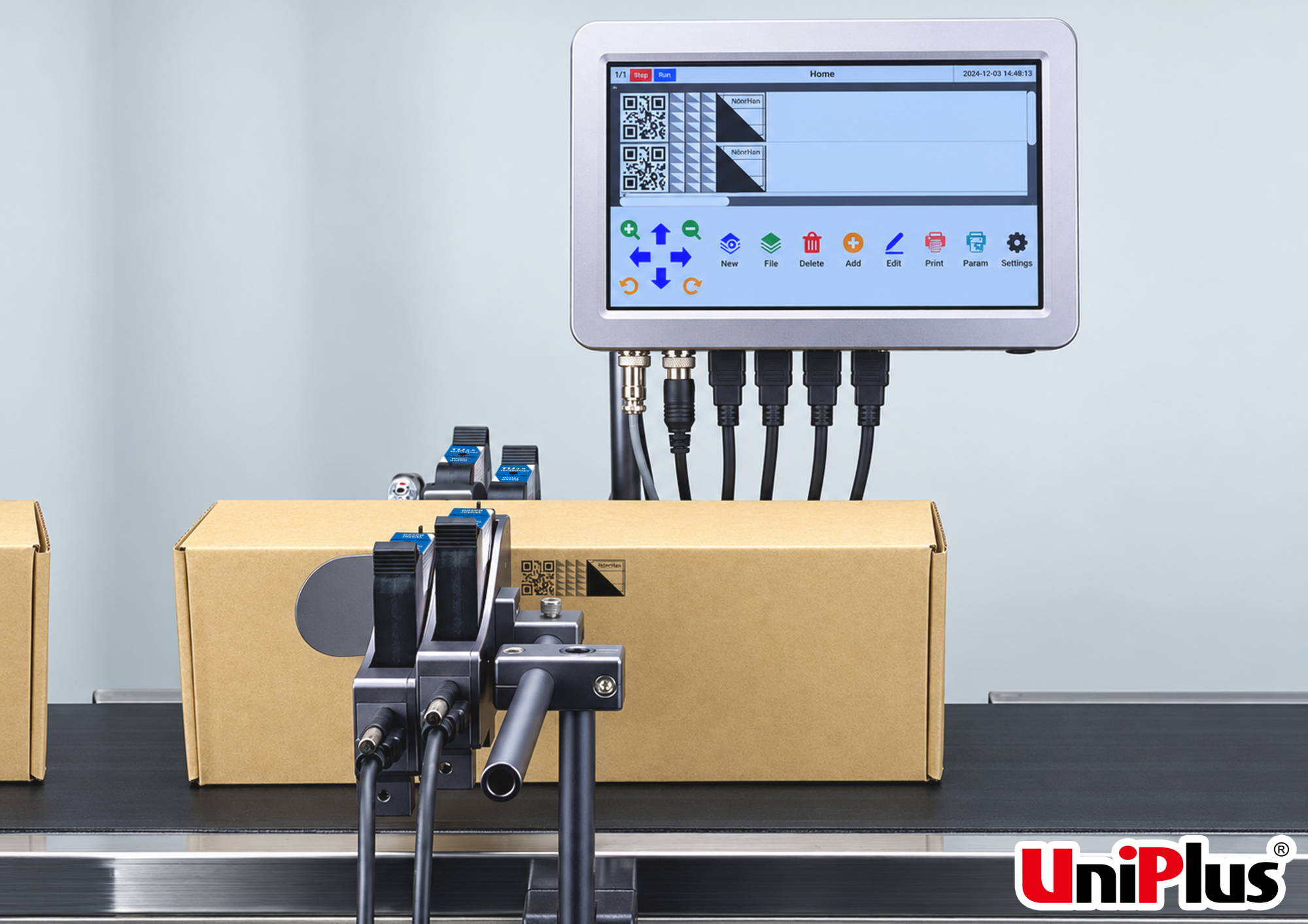
Multiple TIJ printheads arranged to extend the total vertical print height.
This approach requires control of mechanical alignment, timing synchronization, and visual continuity at the seam. An upgrade kit may make a format change simpler; where the controller already supports multiple channels and the machine has enough space, stitching may require less work. The appropriate route depends on the actual controller and mechanical conditions.
How to Decide Between Half-Inch and One-Inch
The decision should follow the print requirement and installed equipment:
- New equipment: specify one-inch unless the marking content is certain to stay within 12.7 mm over the long term.
- Existing half-inch equipment with content within 12.7 mm: staying with half-inch is generally the lower-cost route.
- Content above 12.7 mm: assess one-inch or multi-head stitching.
Use this sequence:
- List every field and line in the print content and measure the total vertical height.
- Confirm the applicable barcode scanning environment and minimum bar height.
- Check supported cartridge sizes, available mounting positions, and controller capability.
- Match ink type to substrate coating, surface energy, drying time, and adhesion requirements.
- Trial-print the actual content on the real substrate at production line speed.
Information to Prepare Before Enquiring
- Equipment brand and model.
- A photo or part number of the current cartridge.
- A sample of the print content, including line count and character height.
- The substrate.
- Line speed.
- Any GS1 or downstream customer barcode requirement.
Visit the Uniplus PRM-Taiwan showroom to review its industrial TIJ products, or send Uniplus an inquiry through PRM-Taiwan with the information above for compatibility assessment.

Founded in 2002, UniPlus Technology Corporation is a premier Taiwan-based manufacturer specializing in the R&D and production of TIJ 2.5 thermal inkjet cartridges for industrial coding and marking applications. With over two decades of expertise, we have evolved from producing OEM-compatible desktop ink cartridges to developing high-performance industrial solvent-based and water-based TIJ 2.5 ink cartridge series. Our products serve diverse industries globally, including food and beverage packaging, pharmaceuticals, logistics, and building materials. We pride ourselves on offering custom chips and printhead designs, multi-substrate printing compatibility, and 100% pre-shipment quality testing. UniPlus is your trusted global B2B partner for reliable, high-resolution industrial inkjet printing solutions.