

 English - EN
 繁體 - ZH-TW
 简体 - ZH-CN
 Español - ES
 日本語 - JA
 العربية - AR
 Русский - RU
 Français - FR

Surface Decoration Guide for Plastic Parts: Water Transfer Printing and the Alternatives
A molded PP cap comes out of the tool in one flat color. Everything else the buyer sees (wood grain, a logo, a metallic ring) is added afterward, or built in during molding. Which method fits depends on four things: the shape of the part, the production volume, the resin, and how much wear the finish has to survive.
One note before the methods. PP and PE have low surface energy, so ink and paint do not stick to them untreated. These parts need flame, corona, or plasma treatment, or an adhesion primer, before most of the processes below. ABS and PS are usually easier to coat.
Water Transfer Printing (Hydrographics)
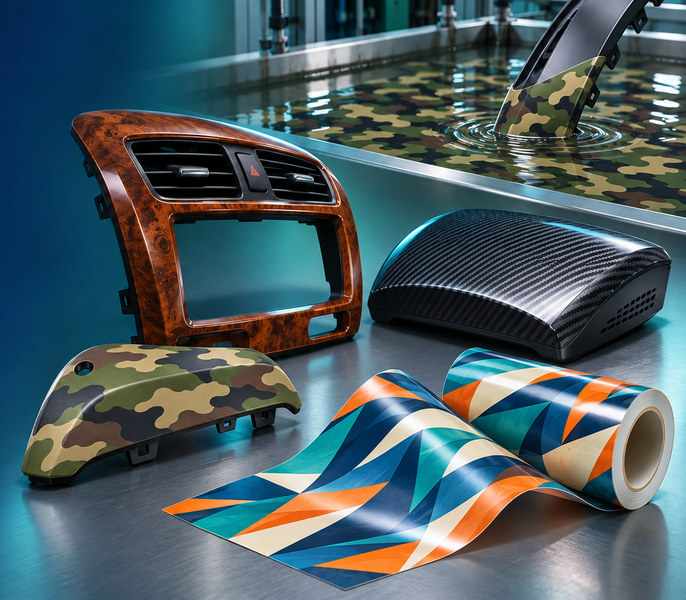
Water transfer printing puts a continuous pattern on three-dimensional shapes that a flat print head or a dry film cannot follow. It is common on automotive interior trim, cosmetic caps, helmets, sporting goods, and electronics housings.
- Prepare and base coat. Parts are cleaned of mold-release residue and dust, then primed and painted with a colored base coat. The base coat shows through the pattern, so it sets the background tone.
- Float and activate the film. A polyvinyl alcohol (PVA) film printed with the pattern is laid on a temperature-controlled water tank. The water dissolves the PVA. An activator is then sprayed on to turn the dry ink back into a liquid layer floating on the surface.
- Dip. The part is lowered through the ink at a controlled angle and speed, and water pressure wraps the ink around it.
- Rinse, dry, and topcoat. Rinsing removes the PVA residue. After drying, a clear topcoat (matte, satin, or gloss) protects the print from scratches and UV.
The limits are worth knowing before you commit. The pattern stretches over deep recesses and cannot be placed at an exact position, so the process suits all-over designs such as wood grain, carbon fiber, stone, and camouflage, not logos or text. Parts wrapped all the way around leave a join line that has to be hidden. And the base coat and topcoat mean a painting line is part of the investment.
Heat Transfer Printing
Heat transfer moves a finished multi-color image from a carrier film to the part in one dry step. The design is gravure-printed in reverse on a PET film that carries a release layer and a heat-activated adhesive. A heated silicone roller or flat pad presses the film against the part, the image bonds, and the carrier peels away.
The ink is already printed and dry on the film, so a full-color image with gradients goes on in one pass with no drying oven. It works on flat, cylindrical, oval, and tapered walls: pails, cups, bottles, cosmetic tubes. It does not work on deep 3D shapes, and each design needs its own film run, which sets a minimum order.
Hot Stamping
Hot stamping uses the same heat-and-pressure principle with a different film: a metallic or holographic foil. A heated die or silicone roller presses the foil onto the part, and the foil stays only where the die touches. It is the standard way to put a gold or silver ring, logo, or line of text on caps, jars, and cosmetic packaging. It is limited to single-foil accents on flat or raised areas.
Pad Printing and Screen Printing
Pad printing picks up ink from an etched plate with a soft silicone pad and presses it onto the part. The pad deforms, so it reaches curved and recessed spots that other print methods miss. Use it for small logos, icons, and scale markings. The image area is small and each color needs its own station.
Screen printing pushes ink through a mesh stencil. It lays down a thick, opaque layer, which suits bold logos and text on bottles, tubes, and flat panels. It prints one color per pass and needs a flat or cylindrical surface.
Both have low tooling cost, so they fit short runs and simple designs of one to four colors.
In-Mold Labeling (IML)
In IML, a robot places a pre-printed PP label in the open injection or blow mold, and the molten resin fuses to it. The label becomes part of the wall, so there is no edge to peel and no labeling step after molding. If the container is also PP, the whole pack is one material for recycling.
IML is the usual choice for dairy tubs, paint pails, and other high-volume containers. It needs a mold and robot built for it, so it rarely pays off for small runs.
In-Mold Decoration (IMD)
IMD covers two processes for durable goods such as appliance panels, automotive interiors, and laptop covers.
In in-mold roller transfer (IMR), a printed carrier foil indexes through the mold. During injection the ink layer bonds to the part, and the carrier is pulled away when the mold opens. In film insert molding (FIM, also called IMF), a printed PC or PMMA film is thermoformed, trimmed, and placed in the mold. The film stays on the part as the outer surface, with the ink behind it where it cannot be scratched from the front.
Both give very durable graphics and both carry high tooling cost, so they belong to long production runs.
Coating, Metallizing, and Marking
Four more processes round out the list.
- Spray painting and UV coating add color, gloss, or a soft-touch feel. They also supply the base coat and topcoat for water transfer.
- Vacuum metallizing and electroplating give plastic a metal surface. ABS and PC/ABS are the standard grades for plating.
- Laser marking burns codes, serial numbers, or backlit symbols into the part with no ink.
- UV inkjet printing needs no plate or film, so it suits short runs and variable designs on flat or cylindrical parts.
Quick Comparison
|
Method |
Best geometry |
Best for |
Main limit |
Typical products |
|---|---|---|---|---|
|
Water transfer |
Complex 3D shapes |
All-over patterns |
No exact positioning; needs paint line |
Auto trim, helmets, cosmetic caps |
|
Heat transfer |
Flat, cylindrical, tapered |
Full-color images |
Not for deep 3D; film minimums |
Pails, cups, bottles, tubes |
|
Hot stamping |
Flat or raised areas |
Metallic accents |
One foil per hit |
Caps, jars, luxury packs |
|
Pad printing |
Small curved or recessed areas |
Logos, icons, markings |
Small image area |
Caps, switches, medical parts |
|
Screen printing |
Flat or cylindrical |
Bold opaque graphics |
One color per pass |
Bottles, tubes, panels |
|
IML |
Tubs, lids, bottles |
High-volume packaging |
Dedicated mold and robot |
Dairy tubs, paint pails |
|
IMD (IMR / FIM) |
Panels and shaped covers |
Wear-resistant graphics |
High tooling cost |
Appliance panels, car interiors |
Sourcing Water Transfer Lines on PRM
A water transfer line only works when the film, activator, base coat, and machines match. Buyers who source film from one vendor and equipment from another often run into mismatched tank temperatures, spray pressures, or film dissolution rates, and each of those shows up as rejected parts.
On PRM platform, buyers can find suppliers that make both the film and the machines. Each listing has specifications and machine videos, and you can send an inquiry from the page.
A standout example on the PRM platform is Yuan Heng Tai Water Transfer Printing Co., Ltd. (YHT). Based in Taichung, Taiwan, the company has made water transfer films since 1990 and builds the machines to run them.
- Film library. YHT produces thousands of patterns, including wood grain, carbon fiber, camouflage, stone, and metallic finishes, and designs custom patterns to a brand's specification.
- Equipment. The machine range runs from manual dipping tanks for small batches to automatic dipping lines, with activator spraying systems and washing stations.
See YHT's films and machines on PRM-Taiwan
We have over 200 of the biggest and many of the smallest Taiwanese machinery manufacturers on our site and contacts with many more. Whether you are looking for full lines such as, recycling machines extruders, blow molding machines, injection molding machines and printing machines, or auxiliary equipment and parts such as gearboxes, barrels, screws, molds, dies, control systems and virtually anything related to the plastic and rubber industries including packaging. If it’s made in Taiwan, we will find it for you!